Figures read 26 October 2026 Bill C06, first printing
Slots sign up bonus: £15 of credit comes to £9.00, and 60p covers staking it
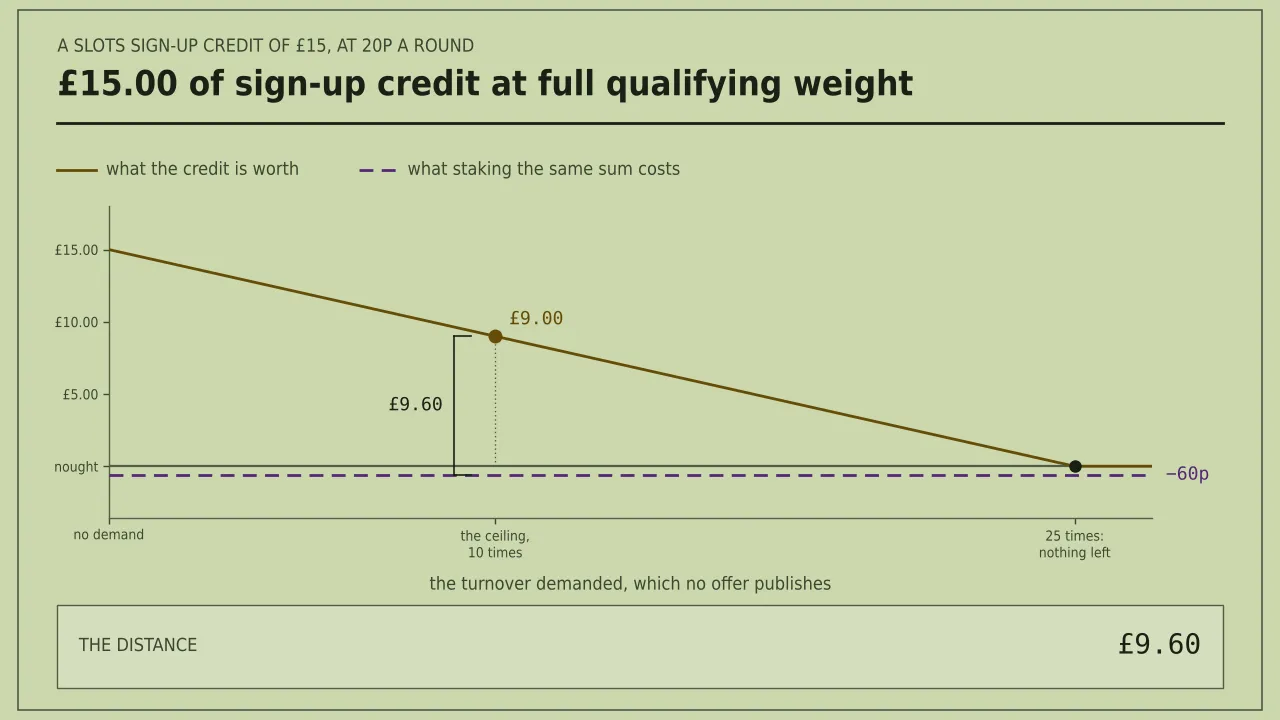
Credit handed over on registration is a sum and not a count, so the sum is where the reckoning has to begin. Fifteen pounds of it a figure fixed here, under a condition of ten turnovers and priced where four pence of a played pound stays behind, is worth £9.00. The very same £15.00 staked by the reader goes through for an expected 60p and leaves nothing behind it. The findings are £9.60 apart, 48 rounds at 20p, and the figure with the power to move them furthest is not the turnover count at all but how much of a staked pound the terms agree to count. Ten turnovers exhausts what a licensee may lawfully be asked, so £9.60 lies beneath the distance as a floor and never across the middle of it.
| What is being priced | Priced as a free round | Priced as a paid round | The gap between the two |
|---|---|---|---|
| Handed over at sign-up | nothing | £15.00 | £15.00 |
| Showing as credit | £15.00 | £15.00 | none |
| Cost of turnover one | 60p | 60p | none |
| Cost of turnovers two to ten | £5.40 | nothing owed | minus £5.40 |
| What it comes to | £9.00 | minus 60p | £9.60, or 48 rounds |
What the free round comes to £9.00 A hundred and fifty pounds of play has to come off £15.00 of credit; that play costs £6.00, and £9.00 outlives it. What the paid round comes to minus 60p Fifteen pounds belonging to the reader, over one pass of the same play, with no turnover owed on anything it wins. The gap, in money and in rounds £9.60, 48 rounds The smaller figure taken from the larger, and the remainder converted into rounds at the stake fixed here.
Free rounds and what each asks in return
Paid placements are what these addresses are. A registration made through one brings this publisher a fee. Neither quote knows which address is which, and no figure on a bout would differ if it did.
-
01Free Play Arena
Betportal
Thirty-five times, three deposits
What the free side comes tonothing150 rounds at 10c, across a play-through of 35 timesWhat the same play costs paid forminus 60cthe identical play behind the reader's own stake, where the only cost is the return itself and no play-through is owedThe distance, in money and in rounds60cthe two findings subtracted, and the same distance said again as 6 rounds at the stake aboveOffered free
How the free side is pricedA count of rounds the offer stakesRounds counted150 roundsWorth of one round10cstated by this publisher, as a quantity of the money this offer is quoted in, no operator having valued a round of its ownCredited as a sumunpublishedCredit waiting on a paymentstated300% over three deposits, ceiling €1,000The face of it€15.00Rounds priced at the stake this publisher states, in the money this offer is quoted in, no operator having valued a round of its ownAsked in return
Play-through35 timesthe bonusCredited towards it100 per centno share has been published anywhere, so every penny counts, that being the kindest available reading of the silencePrices out above25 timesagainst the return assumed here and the share above, any play-through beyond this leaves the free quote worth nothing whateverCeiling on winningsstatedFive times the bonusLargest stake while it runs€5.00capping the stake closes off part of whatever range a lobby offers, and keeps it closed while the credit lastsQualifying payment€20.00200 rounds at the worth above, and no price here touches itOne play priced on both sides of the free line Priced step by step With the offer staking With the reader staking The distance What goes in first nothing minus €15.00 €15.00 What the staking hands back €14.40 €14.40 none What the play-through takes minus €20.16 nothing owed minus €20.16 What it comes to nothing minus 60c 60c, or 6 rounds The play-through asked here is at or past 25 times, the point where the condition costs more than it is laid against, so the free side comes to nothing whatever and the distance is the paid cost by itself.
No licence for Great Britain
Licence held in Anjouan, Comoros, by BetPortal Gaming Ltd, with Excite Ultra Media Ltd, under number ALSI-202601040-FI2.
Open the offer at Betportal, opens in a window of its own -
02Free Play Arena
WinBeast
Five deposits, with a free bet
What the free side comes tonothing500 rounds at 10c, across a play-through of 40 timesWhat the same play costs paid forminus €2.00the identical play behind the reader's own stake, where the only cost is the return itself and no play-through is owedThe distance, in money and in rounds€2.00the two findings subtracted, and the same distance said again as 20 rounds at the stake aboveOffered free
How the free side is pricedA count of rounds the offer stakesRounds counted500 roundsWorth of one round10cstated by this publisher, as a quantity of the money this offer is quoted in, no operator having valued a round of its ownCredited as a sumunpublishedCredit waiting on a paymentstated50% to 100% over five deposits, each ceiling €1,000, with a €650 free betThe face of it€50.00Rounds priced at the stake this publisher states, in the money this offer is quoted in, no operator having valued a round of its ownAsked in return
Play-through40 timesthe bonus and the winnings from the spinsCredited towards it100 per centno share has been published anywhere, so every penny counts, that being the kindest available reading of the silencePrices out above25 timesagainst the return assumed here and the share above, any play-through beyond this leaves the free quote worth nothing whateverCeiling on winningsstated€100 a batch of spinsQualifying payment€20.00200 rounds at the worth above, and no price here touches itOne play priced on both sides of the free line Priced step by step With the offer staking With the reader staking The distance What goes in first nothing minus €50.00 €50.00 What the staking hands back €48.00 €48.00 none What the play-through takes minus €76.80 nothing owed minus €76.80 What it comes to nothing minus €2.00 €2.00, or 20 rounds The play-through asked here is at or past 25 times, the point where the condition costs more than it is laid against, so the free side comes to nothing whatever and the distance is the paid cost by itself.
No licence for Great Britain
Licence held in Curaçao, behind a company the site declines to name.
Open the offer at WinBeast, opens in a window of its own -
03Free Play Arena
EliteSpin
Forty times, five deposits
What the free side comes tonothing500 rounds at 10p, across a play-through of 40 timesWhat the same play costs paid forminus £2.00the identical play behind the reader's own stake, where the only cost is the return itself and no play-through is owedThe distance, in money and in rounds£2.00the two findings subtracted, and the same distance said again as 20 rounds at the stake aboveOffered free
How the free side is pricedA count of rounds the offer stakesRounds counted500 roundsWorth of one round10pstated by this publisher, as a quantity of the money this offer is quoted in, no operator having valued a round of its ownCredited as a sumunpublishedCredit waiting on a paymentstated50% to 100% over five deposits, each ceiling £1,000The face of it£50.00Rounds priced at the stake this publisher states, in the money this offer is quoted in, no operator having valued a round of its ownAsked in return
Play-through40 timesthe bonus and the winnings from the spinsCredited towards it100 per centno share has been published anywhere, so every penny counts, that being the kindest available reading of the silencePrices out above25 timesagainst the return assumed here and the share above, any play-through beyond this leaves the free quote worth nothing whateverCeiling on winningsstatedFive times the bonusQualifying payment£20.00200 rounds at the worth above, and no price here touches itOne play priced on both sides of the free line Priced step by step With the offer staking With the reader staking The distance What goes in first nothing minus £50.00 £50.00 What the staking hands back £48.00 £48.00 none What the play-through takes minus £76.80 nothing owed minus £76.80 What it comes to nothing minus £2.00 £2.00, or 20 rounds The play-through asked here is at or past 25 times, the point where the condition costs more than it is laid against, so the free side comes to nothing whatever and the distance is the paid cost by itself.
No licence for Great Britain
Licence held in Costa Rica, by PrimeTier Limited.
Open the offer at EliteSpin, opens in a window of its own -
04Free Play Arena
Nightluck
No play-through published
What the free side comes toNOT STRUCKNot struck in full, for want of the count of rounds this offer puts up.What the same play costs paid forNOT STRUCKNot struck in full, for want of the count of rounds this offer puts up.The distance, in money and in roundsUNPRICEDone of the two sides is short of a figure, so nothing is subtracted here and nothing is struckOffered free
How the free side is pricedA count of rounds the offer stakesRounds countedunpublishedWorth of one round10pstated by this publisher, as a quantity of the money this offer is quoted in, no operator having valued a round of its ownCredited as a sumunpublishedCredit waiting on a paymentstated100% of the first deposit, ceiling £300The face of itunpublishedAsked in return
Play-throughunpublishedThe offer page sends a reader to the terms for the multiple and prints no figure itselfCredited towards it100 per centno share has been published anywhere, so every penny counts, that being the kindest available reading of the silencePrices out above25 timesagainst the return assumed here and the share above, any play-through beyond this leaves the free quote worth nothing whateverCeiling on winningsunpublishedQualifying payment£10.00100 rounds at the worth above, and no price here touches itNot struck in full, for want of the count of rounds this offer puts up.
No licence for Great Britain
The site names no jurisdiction for its licence, behind a company the site declines to name.
Terms read 22 October 2026
Open the offer at Nightluck, opens in a window of its own
Three quantities on a bout were worked out here. Everything else was transcribed. The free quote comes off E = B × (1 − W × (1 − RTP) ∕ g), where W is whatever play-through the terms demand, g is the proportion of a qualifying stake that counts towards it, RTP is the return assumed of an ordinary slot, and B is whatever is left standing by the time the condition applies. A batch of rounds surrenders part of itself before that point, every round having staked its value and taken the return against it, while a credited sum surrenders nothing at all yet, nothing having gone through the machine. Past break-even the charge exceeds whatever it is charged against, and the free quote settles at nothing rather than below it, nothing being removable beyond what turned up.
The paid side is cost = N × s × (1 − RTP), and it is the figure that makes this bill different from every other ranking in this network. The identical count of rounds at the identical stake, with the reader's own money behind them, hands the margin over once and owes nothing afterwards, there being no credit to turn over and no ceiling to come under. So the two sides are not two readings of one offer. They are one play at two prices, and the distance between them is what the word free is worth on that bout, said as a sum and said again as a count of rounds, because a reader counts in rounds and pays in money.
Read the reckoning downwards and the distance column adds up to the finding. It opens at whatever the paid side has to put in before a round turns, loses whatever the free side gives up that the paid side does not, and closes at the answer, so the bout can be checked without any of it being worked again. A step where both sides move alike leaves the distance reading none, which says the return treats the two the same way there and the distance is made somewhere else.
On a bout whose free half is a demo, both of its own figures are nought and neither one is approximate. Cash has no route out of a demo, so a demo balance showing five hundred pounds settles at nought, and the distance comes out at exactly what buying the rounds costs. Those noughts are findings rather than figures somebody held back. Where a figure really is absent, one of three words takes its place instead. Stated means a condition written out in sentences, which costs something and offers nothing to subtract. Unpublished means a condition written down nowhere whatever. Unpriced means a count published clearly enough, with nothing anywhere putting a value on one of them. None of the three conceals an approximation, and nobody here is credited with a figure they never supplied.
Two figures on every bout belong to this publisher and are stated rather than read. The return both sides are worked at is a general industry figure for an ordinary slot: it is an assumption of this publisher's, it is not read off any title or off anybody who builds one, and a line that spends it says so where it spends it. The worth of one round is the other, and it is spent only where no operator has put a worth on one of its own, nobody publishing a minimum or a maximum for that and no rule setting either. Every bout spending that figure prints whose figure it is. Everything else in a bout was quoted out of an operator's own terms on the day recorded at its foot.
Four duties written by a Great Britain licence come down on the free column of a bout. None of the four comes down on the paid column, because nothing is advanced there for a condition to attach itself to, and that lopsidedness is the argument of the whole bill. Limb 3(a) of Social Responsibility Code 5.1.1 took effect on 19 January 2026 and forbids a holder to ask that bonus funds be played through more than ten times over. Read the play-through term above against that: anything beyond ten times is a term no British holder could have published. Whether a free round counts as bonus funds for the purposes of that limit has not been published in either direction, so this publisher asserts neither reading of it. Statutory Instrument 2025 No. 215, made on 25 February 2025, inserted regulation 5(2), under which no individual may stake more than £5 on a single game cycle of an online slot, falling to £2 under the age of 25. That limit fastens itself to the operating licence rather than to any game, so beyond the licence a lobby offers whatever stake range it pleases with nothing standing over the top of it. Requirement 3C of the remote technical standards obliges a holder to make the rules of a game available before anybody commits money to it. Both quotes above rest on an assumed return rather than a published one, and that duty is the reason an assumption is needed at all out here. Membership of Gamstop Online is a condition of holding the British licence, so the scheme stretches exactly as far as the licence stretches and no further. An offer licensed beyond it sits outside by construction, and a registration somebody has already completed does not reach this offer. Free and confidential help is on the National Gambling Helpline, 0808 8020 133, answering 24 hours a day on every day of the year.
Any condition quoted on a bout appears in the words of whoever published it, and every bout states the day somebody read it. The furthest back of those days on this bill is 22 October 2026. What binds a reader is an operator's own terms, entire, and never a line of this.
1
What the word slots adds to a plain sum of credit
Of the two words doing work in this key, bonus supplies the quantity and slots supplies the weighting. A sum of credit arrives in a balance with no rounds attached and no stake named, so there is nothing to multiply out and the reckoning starts at the sum. What the other word settles is which games the sum may be spent on, and that question turns out to govern the answer more tightly than the size of the sum or the number of turnovers demanded.
The reason is in the machinery of a turnover condition. A condition is discharged not by staking but by staking on something that counts, and how much a staked pound counts for is a term set game by game. Where a pound discharges a whole pound of the condition, ten turnovers of £15.00 means £150.00 of play. Where a pound discharges fifty pence, the same ten turnovers means £300.00. Nothing about the headline has changed and the work has doubled, which is why part four is the longest part of this bill.
Credit aimed at reel games is the kind most likely to be counted whole, and that is why this key sits where it does. The games usually written in at the full rate are reel games, and games written in at a fraction tend to be the table and live varieties. So a sign-up credit labelled for reel games is the kindest case the arithmetic meets, which puts £9.00 at the top of the range the weighting opens rather than somewhere inside it. Part five prints the rest of the range, down to nought.
Two figures have to be supplied before any of this can be worked, and neither is published. One is the return, taken here as 96 per cent, which this publisher applies across the industry and lifts from no catalogue of titles assumed, not read. The other is the stake per round, 20p also fixed by us, which is needed only to turn money back into rounds at the end and affects no valuation. Both are flagged in every sentence that spends them, which is how this site treats a quantity it has supplied rather than found.
2
Fifteen pounds of credit under a condition of ten turnovers
The house expression is E = B × (1 − W × (1 − RTP) ∕ g), and this bill reads it backwards from g, because g is where the argument is. What g names is the fraction of a staked pound that counts; RTP the fraction of it that returns; W the number of times the credit must go round; B the credit itself. Enter £15.00, a count of ten, 96 pence returning and a pound counting whole, and the answer is £9.00.
The ten comes off the rule sheet rather than off a cashier a regulated ceiling: British rules stop an incentive’s turnover condition there, which makes it the most forgiving number obtainable and not a representative one. The weighting at a whole pound is this bill reading silence generously, since no contribution rate has been published for a shape of offer rather than a document, and the line spending it says as much.
Step by step, so the result can be checked without the expression. Ten turnovers of £15.00 calls for £150.00 of play. Of every pound played, four pence stays behind, so £150.00 of play is expected to shed £6.00. Fifteen pounds less £6.00 leaves £9.00, and three fifths of a credited sum is what gets through ten turnovers at this return whatever the sum happens to be. At 20p a round, £150.00 of play is 750 rounds.
Two qualifications sit on the £9.00 and neither is small. The first is statistical: the figure is what the arithmetic expects over many attempts, while a single attempt at £150.00 of play off £15.00 of credit most often ends empty, and a minority of attempts hold the expectation up. The second is legal: ten turnovers binds a British licensee, and a cashier of this kind operates beyond any Great Britain licence, so the condition could be any size at all and part five shows what that does.
3
The very same fifteen pounds staked by the reader instead
Here is the second price, and the second price is why this page exists. Let the £15.00 belong to the reader and cross the same reels once. No credit has been given, so no condition can attach: there is no turnover count, no weighting to discover, no cap on winnings and no window to beat. What remains is the price of play, charged a single time and charged the same as it is charged to credit.
Fifteen pounds across play of the sort assumed here comes back as £14.40 on expectation, so the pass costs 60p. The bill carries that as minus 60p, money having gone out and £14.40 having come back. Put beside the £9.00 on the credit side, the pair are £9.60 apart, and £9.60 at 20p a round is 48 rounds of play.
a credited £15.00 valued at £9.00, the same £15.00 out of the reader’s own pocket costing 60p, £9.60 between the findings and 48 rounds of play in that difference
Sixty pence against £6.00 is the whole of it. The price per pound played is identical on both sides of this bill and takes no interest in who owns the pound. The only thing that differs is how many pounds have to be played: £15.00 once on one side and £150.00 on the other. A turnover condition does not charge a fee. It obliges a reader to buy nine further passes of play, and those nine cost £5.40 between them.
One asymmetry deserves stating because a reader feels it rather than computing it. On the paid side the £15.00 can be stopped at any moment: somebody who puts £4.00 through and walks away keeps £11.00 or whatever the play has made of it, the 60p having only ever been the price of a full pass. On the credit side stopping and forfeiting are the same act. Somebody who produces £90.00 of the £150.00 and stops has got three fifths of the way and collected nothing, so the £9.00 belongs only to whoever finishes. Partial effort earns a partial share of nought, and that is the sharpest line between money a reader owns and money a reader is working towards.
The practical reading is mild. Credit worth about £9.00 for nothing is worth accepting, and a reader who treats it as £15.00 has overstated it by two fifths. What deserves more attention than either number is the £150.00, because that is a commitment rather than an expectation, and it is met in full by everybody who collects and by everybody who collects nothing.
4
The weighting, which decides more than the turnover count does
A weighting is a conversion rate between money staked and condition discharged, and it sits in the expression as a divisor, which is why it has more leverage than anything else in there. Doubling the turnover count doubles the play owed. Halving the weighting also doubles the play owed. But the turnover count is advertised and the weighting is not, so a reader comparing offers is comparing the term with the smaller effect and the larger font.
| A staked pound counts as | Play ten turnovers then needs | What £15.00 is valued at |
|---|---|---|
| 100p | £150.00 | £9.00 |
| 70p | £214.29 | £6.43 |
| 50p | £300.00 | £3.00 |
| 30p | £500.00 | nothing |
| 10p | £1,500.00 | nothing |
The thirty-pence line is not invented. Thirty pence in the pound is the contribution rate that appears in the British regulator’s own consultation on these conditions read off the rule sheet, where the example runs on a hundred pounds of credit, and it is the only weighting figure on this publisher’s rule sheet traceable anywhere official. Applied to £15.00 it needs £500.00 of play, which is 2,500 rounds at the stake fixed here, and it values the credit at nought.
A weighting can also be nought, and that case carries a name instead of a number. A game shut out of a condition counts for nothing whatever, so no amount of play on it discharges a single penny of the £150.00 and the division cannot be done at all: the credit stays uncollectable there for as long as anybody cares to keep pressing. An exclusion list is therefore not a footnote to the weighting but its limiting case, and it bites hardest where the games shut out are the ones a reader would otherwise pick. Somebody holding £15.00 of credit and a list of exclusions has a smaller menu than somebody holding £15.00 of their own, and that is a cost the table above cannot show, not being denominated in pounds.
The spread down that last column is the finding of this part. One sum of £15.00, under one advertised condition, comes to £9.00, £6.43, £3.00 or nothing, and which of the four depends wholly on a term no headline carries. Top line to bottom line, the spread is the whole credit. No change to the turnover count inside the regulated ceiling can produce a spread of that width, because the ceiling caps the count at ten and the weighting has no floor at all.
Which fixes the order in which the terms deserve reading. Find the weighting first. Find the turnover count second. The size of the credit comes third, because it scales every figure in the table without altering a single proportion in it. A reader who has the weighting and the turnover count can value any sum of credit in two steps; a reader who has only the sum knows the one thing that cannot be used on its own.
5
Forty pence in the pound, where ten turnovers eat the lot
There is an exact weighting at which a credit under a given condition is worth nothing, and the expression yields it directly instead of anybody looking it up. Run it again, E = B × (1 − W × (1 − RTP) ∕ g), and set the bracket to nought: the weighting that does it is the turnover count multiplied by the share a pound fails to return. At ten turnovers and four pence in the pound that is forty pence. So a ten-turnover condition takes the whole of a credit the moment a staked pound counts for forty pence or less, whatever the credit is.
| Turnovers demanded | Weighting that extinguishes it | Play owed at that weighting |
|---|---|---|
| 10 times | 40p in the pound | £375.00 |
| 15 times | 60p in the pound | £375.00 |
| 20 times | 80p in the pound | £375.00 |
| 25 times | a whole pound | £375.00 |
The third column is constant and that constancy is the point. Whatever combination of condition and weighting extinguishes a credit does so by requiring the same quantity of play, £375.00 on a credit of £15.00, which is twenty-five times the credit. Twenty-five turnovers at a whole pound and ten turnovers at forty pence are the same demand wearing two labels, and a reader shown the second has been shown the gentler-looking of two identical things.
That equivalence is worth carrying, because it turns two unknowns into one. A reader does not need the weighting and the turnover count separately. What they need is the product of the count and the reciprocal of the weighting, which is the number of times the credit has to be played through in real money, and the credit is worth nothing once that number reaches twenty-five. Ten turnovers at fifty pence makes twenty. Ten at thirty pence makes a third over thirty-three, well past the line, and that is why the fourth row of the table in part four reads nothing.
Fold the two terms into one number and this whole bill collapses to a single comparison. Divide the turnover count by the weighting and what comes out is how many times the credit has to cross real play: ten at a whole pound is ten, ten at fifty pence is twenty, ten at thirty pence is a third over thirty-three, and twenty at sixty pence is a third over thirty-three as well. Any pairing that reaches twenty-five describes a credit worth nothing. Any pairing under it can be valued straight off the ratio, what survives being one less that number multiplied by four hundredths, which on £15.00 gives £9.00 at ten, £3.00 at twenty and nought from twenty-five up.
British rules cap the advertised count at ten and say nothing at all about the weighting, which leaves the quantity that actually matters uncapped even inside the licensed market from the rule sheet. The regulator recorded the weighting point when it consulted and did not act on it. Outside that market neither half is capped, so the twenty-five can be reached by the count alone, by the weighting alone, or by both together.
6
A practice balance of fifteen pounds, and the nought it yields
Nothing comes out of a practice balance. Not a trimmed £9.00, not the same £9.00 waiting on a longer condition, and not a sum a cashier would quote if written to: nothing at all, there being no route by which value crosses from a practice balance to a person. A practice balance of £15.00 and a practice balance of five hundred pounds pay the same amount as each other.
Which means the instrument above, applied to practice, has a free column of noughts from top to bottom, a distance identical to the paid column, and a single finding of minus 60p. Those noughts are not absences. They are the measurement. A reader who has spent an hour taking a practice £15.00 up to £200.00 has learned the layout of a reel set and has established nothing whatever about £150.00 of real play, since the thing being established on this bill is a cost and practice is the mode in which costs do not happen.
So four arrangements can show £15.00 and be worth £9.00, £3.00, minus 60p or nought, and no inspection of the screen distinguishes them. What distinguishes them is one divisor and one multiplier sitting in a document, and the document is the only place a reader can find either.
7
A return nobody is obliged to publish, and what rests on it
Every figure on this bill rests on 96 pence coming back out of a played pound, and that assumption deserves one part of its own, because the British rule a reader might expect to guarantee it does not. Before anybody commits, a licensed game owes a reader enough information to form a view of the chances, and four different disclosures will each discharge that duty: an account of the workings and of how a winner is picked; the margin the house holds; the share returned to a player; or the odds on the events that pay off the rule sheet. The four sit in the alternative. A licensed cashier can satisfy the duty while publishing no return figure whatever.
Which leaves the return as a quantity this publisher supplies, declared wherever it is spent, and the consequence of that is arithmetic rather than rhetorical. Move the assumption to 94 per cent and ten turnovers of £15.00 costs £9.00 rather than £6.00, which takes the credit to £6.00 and the single pass to 90p. Move it to 97 per cent and the credit comes to £10.50 against a pass of 45p. The £9.00 is the middle of a band, and anybody who finds a published return for the games a credit may be spent on should put it in and recompute rather than take the band.
Two further rules make the assumption meaningful where they apply, and their absence is a loss worth naming. A licensed game is barred from adapting its own behaviour or shifting the odds behind its outcomes, and the random numbers it draws must be consumed in the order drawn and not set aside. It is barred as well from showing a near miss that never was, or exchanging one losing outcome for another. Without those, an assumed return is an assumption about a mechanism nobody has undertaken to keep fixed.
One further consequence follows from the return being supplied rather than read, and it concerns what this bill would do if a figure did turn up. Where a cashier publishes a return for the games a credit may be spent on, that figure displaces the 96 per cent and every quantity above moves with it in a single step, since what survives is one less the turnover count multiplied by the share a pound fails to return. Two points lower lifts the cost of the condition by half, taking £6.00 to £9.00 and the finding from £9.00 down to £6.00. What this bill will not do is attach a return to a named title or lift one off a maker’s own sheet, this publisher keeping no such sheet and a figure of that kind being sourced to nowhere.
One more remark on the character of £9.60. The figure is a floor, since ten turnovers exhausts what a licensee may lawfully be asked, so nothing the law allows brings the distance under it, while a count of five would raise it to £12.60. A cashier outside that regime meets no ceiling, and above it the gap shrinks: £3.60 at twenty turnovers, 60p at twenty-five, the 60p being one crossing of the credit. A floor states at least, which leaves a reader better off than told rather than worse.
Whoever puts a sign-up credit of this kind to a reader in Great Britain is holding no Great Britain licence. Three duties such a licence carries bear on the figures above. First the information duty just described, which a licensee may discharge with a margin or a set of odds in place of a return, so even a licensed site cannot be assumed to print the figure the £9.00 depends on. Second the bar on a game compensating, on shifting the odds behind its results, and on throwing away random numbers it dislikes, which is what makes a published return mean what it says. And third the bar on a near miss that was never near anything. Strip all three out and the 96 pence this bill assumes is a figure resting on nobody’s undertaking, which is exactly why it is printed as an assumption and not as a reading.
The finding runs to four lines. A sign-up credit for reel games is a sum, not a count, so the arithmetic starts at £15.00. Under ten turnovers and a whole pound counting, it is worth £9.00, against 60p to stake the same £15.00, which places the findings £9.60 or 48 rounds apart. The weighting, not the turnover count, is the term with the power to move that: £9.00 at a whole pound, £3.00 at fifty pence, nought at forty pence or below, so the single number a reader needs is the count divided by the weighting and the credit dies when it reaches twenty-five. And the return underneath all of it is this publisher’s assumption, because no licensed cashier is obliged to publish one.
Questions
- How much is £15 of slots sign-up credit worth after wagering?
- £9.00, where the condition is ten turnovers, a staked pound counts whole, and 96 pence returns out of each pound played. The play owed is £150.00. Putting the same £15.00 through as money of the reader’s own would cost 60p, so the two findings are £9.60 apart, which is 48 rounds at the 20p fixed on this bill.
- Why does game weighting matter more than the wagering multiple?
- Because the weighting divides where the multiple merely multiplies, and British rules cap the multiple at ten while leaving the weighting alone. The same £15.00 of credit is worth £9.00 at a whole pound, £6.43 at seventy pence, £3.00 at fifty pence and nothing at thirty, and none of those weightings appears in a headline.
- At what game weighting does bonus credit become worthless?
- At forty pence in the pound, where the condition is ten turnovers. The weighting that extinguishes a credit is the turnover count multiplied by the four pence a pound fails to return, so ten turnovers dies at forty pence, fifteen at sixty, and twenty at eighty. All four demand the same £375.00 of play off £15.00 of credit.
- How much play does £15 of sign-up credit ask for?
- £150.00 at ten turnovers with a pound counting whole, which is 750 rounds at 20p. At fifty pence in the pound the same condition wants £300.00, and at the thirty pence recorded in the British regulator’s consultation it wants £500.00, or 2,500 rounds, at which point the credit is worth nought rather than £9.00.
- Is the 96 per cent return on this page a figure from the game?
- No. It is this publisher’s assumption, applied across the industry and taken from no catalogue of titles. A licensed cashier can discharge its information duty by naming the margin it keeps, or the odds attaching to the events that pay, instead of a return, so no reader should assume the figure is obtainable. At 94 per cent the credit is worth £6.00 and at 97 per cent £10.50.
- Does practice mode tell me anything about a sign-up credit?
- Nothing at all. No route exists by which value leaves a practice balance, so a practice £15.00 and a practice five hundred pounds pay the same amount, which is nought. Both columns of that arithmetic stop at nought, neither of which is an estimate, so an hour of practice says nothing about £9.00, about minus 60p, or about the £150.00 behind the first.