Figures read 26 October 2026 Bill B03, first printing
Deposit 5 get 200 free spins, cheapest door of three: 2.5p a round in, 5.76p a round back
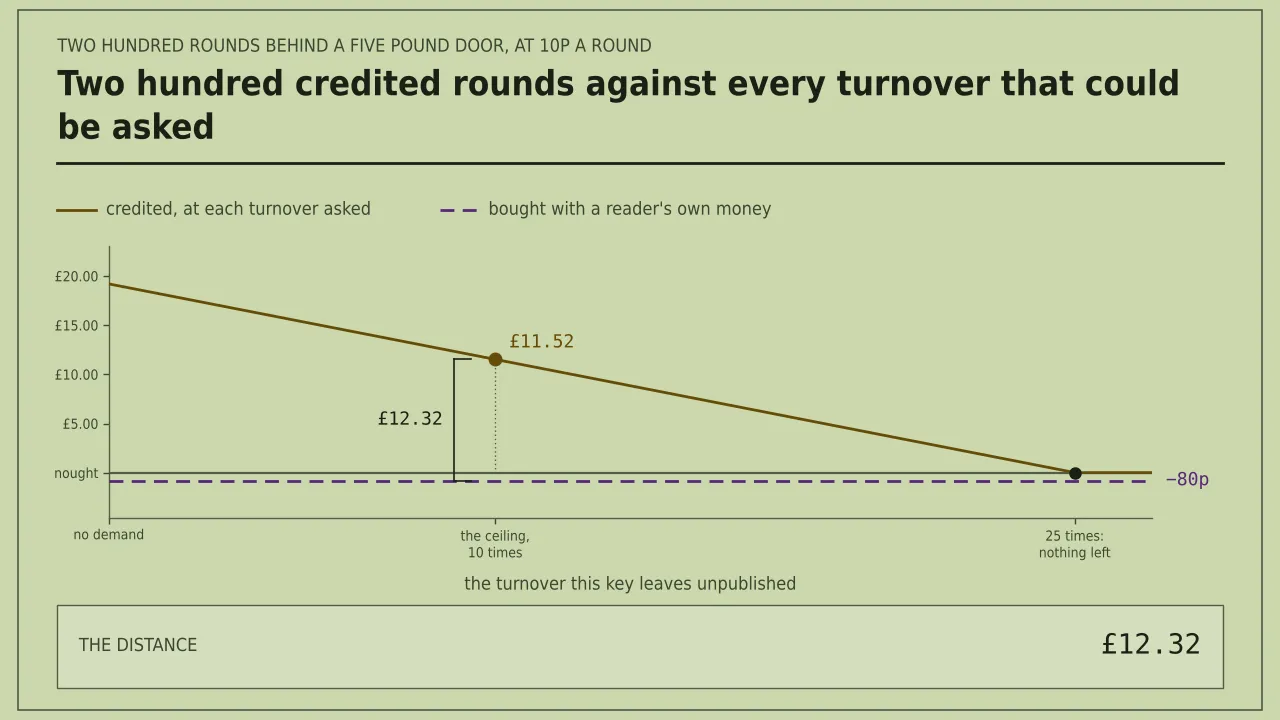
A fiver shared among two hundred rounds works out at 2.5p of cover for one of them, the smallest cover charge any bought count in this section carries. Take a round’s stake as 10p, which is this publisher’s own number and never anybody else’s, and take 96 per cent as what comes back, an industry-wide figure attached to no particular machine. The two hundred then put £20.00 at stake, deliver £19.20 to the balance, and finish at £11.52 once a condition of ten times of staking has crossed it. Bought with a reader’s own money at that stake, two hundred rounds come to a charge of 80p and nothing is owed on anything they take. £12.32 separates the two findings, the same separation reads as 123.2 rounds, and the fiver that opened the thing has gone nowhere.
| What is being priced | Priced as a free round | Priced as a paid round | The gap between the two |
|---|---|---|---|
| Staked before the first round | none | £20.00 | £20.00 |
| Two hundred rounds at 10p | £20.00 | £20.00 | none |
| What the count returns as balance | £19.20 | £19.20 | none |
| Spent on ten times of staking | £7.68 | nothing owed | minus £7.68 |
| Where it finishes | £11.52 | minus 80p | £12.32, or 123.2 rounds |
What the free round comes to £11.52 Two hundred rounds pay their own stake, £19.20 reaches the balance, and £7.68 of it goes on satisfying ten times. What the paid round comes to minus 80p Twenty pounds of staking from a reader’s own pocket, charged at a single pass, with no obligation trailing it. The gap, in money and in rounds £12.32, 123.2 rounds The free finding less the paid one, divided through by the stake so the answer arrives as a number of rounds.
Free rounds and what each asks in return
Paid placements are what these addresses are. A registration made through one brings this publisher a fee. Neither quote knows which address is which, and no figure on a bout would differ if it did.
-
01Free Play Arena
Betportal
Thirty-five times, three deposits
What the free side comes tonothing150 rounds at 10c, across a play-through of 35 timesWhat the same play costs paid forminus 60cthe identical play behind the reader's own stake, where the only cost is the return itself and no play-through is owedThe distance, in money and in rounds60cthe two findings subtracted, and the same distance said again as 6 rounds at the stake aboveOffered free
How the free side is pricedA count of rounds the offer stakesRounds counted150 roundsWorth of one round10cstated by this publisher, as a quantity of the money this offer is quoted in, no operator having valued a round of its ownCredited as a sumunpublishedCredit waiting on a paymentstated300% over three deposits, ceiling €1,000The face of it€15.00Rounds priced at the stake this publisher states, in the money this offer is quoted in, no operator having valued a round of its ownAsked in return
Play-through35 timesthe bonusCredited towards it100 per centno share has been published anywhere, so every penny counts, that being the kindest available reading of the silencePrices out above25 timesagainst the return assumed here and the share above, any play-through beyond this leaves the free quote worth nothing whateverCeiling on winningsstatedFive times the bonusLargest stake while it runs€5.00capping the stake closes off part of whatever range a lobby offers, and keeps it closed while the credit lastsQualifying payment€20.00200 rounds at the worth above, and no price here touches itOne play priced on both sides of the free line Priced step by step With the offer staking With the reader staking The distance What goes in first nothing minus €15.00 €15.00 What the staking hands back €14.40 €14.40 none What the play-through takes minus €20.16 nothing owed minus €20.16 What it comes to nothing minus 60c 60c, or 6 rounds The play-through asked here is at or past 25 times, the point where the condition costs more than it is laid against, so the free side comes to nothing whatever and the distance is the paid cost by itself.
No licence for Great Britain
Licence held in Anjouan, Comoros, by BetPortal Gaming Ltd, with Excite Ultra Media Ltd, under number ALSI-202601040-FI2.
Open the offer at Betportal, opens in a window of its own -
02Free Play Arena
WinBeast
Five deposits, with a free bet
What the free side comes tonothing500 rounds at 10c, across a play-through of 40 timesWhat the same play costs paid forminus €2.00the identical play behind the reader's own stake, where the only cost is the return itself and no play-through is owedThe distance, in money and in rounds€2.00the two findings subtracted, and the same distance said again as 20 rounds at the stake aboveOffered free
How the free side is pricedA count of rounds the offer stakesRounds counted500 roundsWorth of one round10cstated by this publisher, as a quantity of the money this offer is quoted in, no operator having valued a round of its ownCredited as a sumunpublishedCredit waiting on a paymentstated50% to 100% over five deposits, each ceiling €1,000, with a €650 free betThe face of it€50.00Rounds priced at the stake this publisher states, in the money this offer is quoted in, no operator having valued a round of its ownAsked in return
Play-through40 timesthe bonus and the winnings from the spinsCredited towards it100 per centno share has been published anywhere, so every penny counts, that being the kindest available reading of the silencePrices out above25 timesagainst the return assumed here and the share above, any play-through beyond this leaves the free quote worth nothing whateverCeiling on winningsstated€100 a batch of spinsQualifying payment€20.00200 rounds at the worth above, and no price here touches itOne play priced on both sides of the free line Priced step by step With the offer staking With the reader staking The distance What goes in first nothing minus €50.00 €50.00 What the staking hands back €48.00 €48.00 none What the play-through takes minus €76.80 nothing owed minus €76.80 What it comes to nothing minus €2.00 €2.00, or 20 rounds The play-through asked here is at or past 25 times, the point where the condition costs more than it is laid against, so the free side comes to nothing whatever and the distance is the paid cost by itself.
No licence for Great Britain
Licence held in Curaçao, behind a company the site declines to name.
Open the offer at WinBeast, opens in a window of its own -
03Free Play Arena
EliteSpin
Forty times, five deposits
What the free side comes tonothing500 rounds at 10p, across a play-through of 40 timesWhat the same play costs paid forminus £2.00the identical play behind the reader's own stake, where the only cost is the return itself and no play-through is owedThe distance, in money and in rounds£2.00the two findings subtracted, and the same distance said again as 20 rounds at the stake aboveOffered free
How the free side is pricedA count of rounds the offer stakesRounds counted500 roundsWorth of one round10pstated by this publisher, as a quantity of the money this offer is quoted in, no operator having valued a round of its ownCredited as a sumunpublishedCredit waiting on a paymentstated50% to 100% over five deposits, each ceiling £1,000The face of it£50.00Rounds priced at the stake this publisher states, in the money this offer is quoted in, no operator having valued a round of its ownAsked in return
Play-through40 timesthe bonus and the winnings from the spinsCredited towards it100 per centno share has been published anywhere, so every penny counts, that being the kindest available reading of the silencePrices out above25 timesagainst the return assumed here and the share above, any play-through beyond this leaves the free quote worth nothing whateverCeiling on winningsstatedFive times the bonusQualifying payment£20.00200 rounds at the worth above, and no price here touches itOne play priced on both sides of the free line Priced step by step With the offer staking With the reader staking The distance What goes in first nothing minus £50.00 £50.00 What the staking hands back £48.00 £48.00 none What the play-through takes minus £76.80 nothing owed minus £76.80 What it comes to nothing minus £2.00 £2.00, or 20 rounds The play-through asked here is at or past 25 times, the point where the condition costs more than it is laid against, so the free side comes to nothing whatever and the distance is the paid cost by itself.
No licence for Great Britain
Licence held in Costa Rica, by PrimeTier Limited.
Open the offer at EliteSpin, opens in a window of its own -
04Free Play Arena
Nightluck
No play-through published
What the free side comes toNOT STRUCKNot struck in full, for want of the count of rounds this offer puts up.What the same play costs paid forNOT STRUCKNot struck in full, for want of the count of rounds this offer puts up.The distance, in money and in roundsUNPRICEDone of the two sides is short of a figure, so nothing is subtracted here and nothing is struckOffered free
How the free side is pricedA count of rounds the offer stakesRounds countedunpublishedWorth of one round10pstated by this publisher, as a quantity of the money this offer is quoted in, no operator having valued a round of its ownCredited as a sumunpublishedCredit waiting on a paymentstated100% of the first deposit, ceiling £300The face of itunpublishedAsked in return
Play-throughunpublishedThe offer page sends a reader to the terms for the multiple and prints no figure itselfCredited towards it100 per centno share has been published anywhere, so every penny counts, that being the kindest available reading of the silencePrices out above25 timesagainst the return assumed here and the share above, any play-through beyond this leaves the free quote worth nothing whateverCeiling on winningsunpublishedQualifying payment£10.00100 rounds at the worth above, and no price here touches itNot struck in full, for want of the count of rounds this offer puts up.
No licence for Great Britain
The site names no jurisdiction for its licence, behind a company the site declines to name.
Terms read 22 October 2026
Open the offer at Nightluck, opens in a window of its own
Three quantities on a bout were worked out here. Everything else was transcribed. The free quote comes off E = B × (1 − W × (1 − RTP) ∕ g), where W is whatever play-through the terms demand, g is the proportion of a qualifying stake that counts towards it, RTP is the return assumed of an ordinary slot, and B is whatever is left standing by the time the condition applies. A batch of rounds surrenders part of itself before that point, every round having staked its value and taken the return against it, while a credited sum surrenders nothing at all yet, nothing having gone through the machine. Past break-even the charge exceeds whatever it is charged against, and the free quote settles at nothing rather than below it, nothing being removable beyond what turned up.
The paid side is cost = N × s × (1 − RTP), and it is the figure that makes this bill different from every other ranking in this network. The identical count of rounds at the identical stake, with the reader's own money behind them, hands the margin over once and owes nothing afterwards, there being no credit to turn over and no ceiling to come under. So the two sides are not two readings of one offer. They are one play at two prices, and the distance between them is what the word free is worth on that bout, said as a sum and said again as a count of rounds, because a reader counts in rounds and pays in money.
Read the reckoning downwards and the distance column adds up to the finding. It opens at whatever the paid side has to put in before a round turns, loses whatever the free side gives up that the paid side does not, and closes at the answer, so the bout can be checked without any of it being worked again. A step where both sides move alike leaves the distance reading none, which says the return treats the two the same way there and the distance is made somewhere else.
On a bout whose free half is a demo, both of its own figures are nought and neither one is approximate. Cash has no route out of a demo, so a demo balance showing five hundred pounds settles at nought, and the distance comes out at exactly what buying the rounds costs. Those noughts are findings rather than figures somebody held back. Where a figure really is absent, one of three words takes its place instead. Stated means a condition written out in sentences, which costs something and offers nothing to subtract. Unpublished means a condition written down nowhere whatever. Unpriced means a count published clearly enough, with nothing anywhere putting a value on one of them. None of the three conceals an approximation, and nobody here is credited with a figure they never supplied.
Two figures on every bout belong to this publisher and are stated rather than read. The return both sides are worked at is a general industry figure for an ordinary slot: it is an assumption of this publisher's, it is not read off any title or off anybody who builds one, and a line that spends it says so where it spends it. The worth of one round is the other, and it is spent only where no operator has put a worth on one of its own, nobody publishing a minimum or a maximum for that and no rule setting either. Every bout spending that figure prints whose figure it is. Everything else in a bout was quoted out of an operator's own terms on the day recorded at its foot.
Four duties written by a Great Britain licence come down on the free column of a bout. None of the four comes down on the paid column, because nothing is advanced there for a condition to attach itself to, and that lopsidedness is the argument of the whole bill. Limb 3(a) of Social Responsibility Code 5.1.1 took effect on 19 January 2026 and forbids a holder to ask that bonus funds be played through more than ten times over. Read the play-through term above against that: anything beyond ten times is a term no British holder could have published. Whether a free round counts as bonus funds for the purposes of that limit has not been published in either direction, so this publisher asserts neither reading of it. Statutory Instrument 2025 No. 215, made on 25 February 2025, inserted regulation 5(2), under which no individual may stake more than £5 on a single game cycle of an online slot, falling to £2 under the age of 25. That limit fastens itself to the operating licence rather than to any game, so beyond the licence a lobby offers whatever stake range it pleases with nothing standing over the top of it. Requirement 3C of the remote technical standards obliges a holder to make the rules of a game available before anybody commits money to it. Both quotes above rest on an assumed return rather than a published one, and that duty is the reason an assumption is needed at all out here. Membership of Gamstop Online is a condition of holding the British licence, so the scheme stretches exactly as far as the licence stretches and no further. An offer licensed beyond it sits outside by construction, and a registration somebody has already completed does not reach this offer. Free and confidential help is on the National Gambling Helpline, 0808 8020 133, answering 24 hours a day on every day of the year.
Any condition quoted on a bout appears in the words of whoever published it, and every bout states the day somebody read it. The furthest back of those days on this bill is 22 October 2026. What binds a reader is an operator's own terms, entire, and never a line of this.
1
A fiver over two hundred rounds, and 2.5p of cover apiece
Five pounds and two hundred rounds are the only quantities this key publishes, and the interesting number is the one sitting between them. Divide the fiver by the count and a single round has cost 2.5p to reach. That is a cover charge: the sum a reader must put across a counter before anybody will credit a round to them, expressed one round at a time. It is the lowest cover of the three bought counts on this site, a quarter of what a hundred-round key charges on a tenner and three quarters of what a three hundred-round key charges on the same tenner.
A cover charge can be calculated here only because a payment happened. Where a count is handed across for nothing, there is no sum to divide and no price per round to find, so the only honest question about such a count is what its rounds give back. On this key a real payment meets a real count, and the division between them is a fact a reader can repeat with a pencil. Three quantities follow, and all three stand on this bill: 2.5p of cover a round, what one of the two hundred is worth once a staking condition has gone over it, and what two hundred identical rounds would have charged a reader buying them outright.
That third quantity is the one this publisher was built to print, and it is missing from every sibling publication working the same key, none of which carries a paid column at all. Two hundred rounds funded by a reader at 10p apiece, with 96 per cent coming back both figures ours, cost 80p over the whole count. Every step from that 80p across to £11.52 is worked below, and no step rests on a quantity whose origin goes unstated.
Nothing in any of it turns on whose artwork the count lands on. A familiar machine in a lobby is evidence of nothing at all about what a round there gives back, so this bill traces no quantity to a title or to a studio and ranks neither. Four things settle the whole sum: how many rounds, what one stakes, what fraction of staking returns, and how much staking the condition demands afterwards. Of the four, a promotion typically prints the first alone.
2
Four pounds of face for every pound put across the counter
Attach a stake to a count and the count becomes a sum of money. Two hundred rounds at 10p put £20.00 at stake, and £20.00 is the face of this count. Four pounds of face for every pound of deposit is the steepest ratio in this section, and it is the fact that makes this key worth a page of its own: a reader hands over five pounds and is credited with twenty pounds of play.
| What the door asks | Face of the count at 10p | Face for each pound deposited |
|---|---|---|
| £10.00 for 100 rounds | £10.00 | £1.00 |
| £10.00 for 300 rounds | £30.00 | £3.00 |
| £5.00 for 200 rounds | £20.00 | £4.00 |
The right-hand column and the cover charge from part one are the same fact said twice. Four pounds of face for each pound deposited means a quarter of a 10p stake has been paid for at the counter, which is 2.5p, while a ratio of one to one means the whole 10p has been paid for. Whichever way round a reader would rather see it, this key sits at the kind end of both.
A face is not a finding, and the distance between those two words is most of this site. Twenty pounds of face says what the count will put through a game. It says nothing about what the count leaves behind, because a return under a hundred per cent takes a slice of everything that passes and a staking condition arranges for a great deal to pass. Of the £20.00 of face, £19.20 comes back as balance and £7.68 of that is consumed meeting ten times, which is how £20.00 of face turns into £11.52 of finding.
Neither of the two quantities that give a count its face is printed by anybody. No published rule anywhere puts a cash value on a free round nothing in the sheet sets one, so the 10p is a number this publisher states and restates at each use. The fraction coming back is the other, and 96 per cent is taken as a workaday figure for machines of the sort these counts land on: no screen was read for it, no title owns it, and the sentence spending it says as much every time.
3
The fiver priced on its own, which is not the price of the count
The fiver does two unrelated jobs and a page that merges them charges a reader twice for one payment. Job one: it satisfies a condition and two hundred rounds are credited. Job two: it becomes five pounds of balance that belongs to the reader, can be staked, and can be asked for back on whatever terms the cashier has written. Nothing was purchased. A threshold was crossed.
Price the fiver by itself and the number is small. Send five pounds once through a machine giving back 96 per cent this bill’s assumption and £4.80 returns, so one trip has charged 20p. Cost accumulates through repetition, not through size: send the dwindling balance round four times and roughly 75p has gone, round a hundred times and there is next to nothing left. A reader who pays the fiver, collects two hundred rounds and never stakes the fiver itself has paid no cover at all beyond whatever a cashier charges for moving money, and nobody publishes such a charge for a key of this shape, so none appears in these sums.
Set the fiver against the finding instead and a second reading appears. The count comes to £11.52 and the door asked £5.00, so treating the door as a purchase price makes the count look like a clear £6.52 to the good. The flaw in that reading is that the fiver went to nobody: it is still balance. What £6.52 actually measures is the margin by which the count outruns the cover charge, and said one round at a time it is 3.26p, being 5.76p delivered against 2.5p asked.
There is one arrangement in which the offer really does reach the fiver, and this bill declines to price it. Where terms count staking of the deposit towards the condition as well as staking of the credited funds, the base grows from £19.20 to £24.20, and ten times of that asks £242.00 of staking rather than £192.00. The regulator has published no word on whether a condition built that way sits inside its ceiling no published example, so the quantity is named and no total is taken from it.
4
£19.20 of balance and the ten times laid across it
A single quantity settles most of this page, and a reader standing at a cashier is least likely to be holding it. What a balance survives, when a demanded volume of staking has to cross it before it converts, falls out of E = B × (1 − W × (1 − RTP) ∕ g). Four things go in: the balance as it stands, how many times over it has to be staked, how much of all staking a machine hands back, and how heavily a qualifying machine is counted towards the demand. On this count they read £19.20, a multiple of ten, 96 per cent coming home and a weight of full, and £11.52 walks out the other side.
Ten was not taken off the market. A British licence will not let a staking demand go past it, a boundary standing since 19 January 2026 read off the rule sheet and fixed to all classes of licence save those for technical work and for software. Winnings credited as bonus funds have their demand held beneath that ten. Whether the boundary catches a free round on its own account is a question with no printed answer behind it, and nothing here is asserted in either direction. Ten being the outer limit of any lawful demand, it yields the thinnest free column British terms permit: £11.52 is where two hundred given rounds start and not where they stop, since every lawful demand below ten leaves more of the £19.20 standing and more than £12.32 between the columns.
How heavily a qualifying machine counts is the quantity promotions omit most reliably. With no percentage in sight this bill reads the gap in a reader’s favour, weights the machine at full, and repeats as much wherever the weight does any work. Read another way the answer moves hard: at a weight of thirty per cent, a rate put to the regulator by one respondent during its consultation a respondent, not the regulator, ten times of staking against £19.20 demands more than £19.20 can bear and the free finding vanishes. That working is this publisher’s, laid over a rate somebody else put on the record.
Past ten times the arithmetic shortens quickly. Fifteen leaves £7.68 of the £19.20, twenty leaves £3.84, twenty-five leaves nought, and anything further runs the expression below nought where it is then held, no balance being able to give up more than the whole of itself. Twenty-five is the figure to keep hold of. It marks the spot where 4p taken from each pound staked has swallowed the entire balance the count handed across, and an offer licensed elsewhere has nothing in any rulebook keeping it short of that spot.
5
Two hundred rounds bought with a reader’s own twenty pounds
The bought sum is one subtraction with no multiple anywhere inside it. Two hundred rounds funded by a reader’s own 10p send £20.00 through a machine and take £19.20 back out, leaving 80p as the charge for the count. There is nothing else in it. Since no credit changed hands the winnings carry no obligation, no printed ceiling stands over them, and whatever the two hundred rounds do take is spendable from the moment it shows.
Eighty pence for two hundred rounds strikes most people as too cheap, and the answer lies in what a charge is proportional to. Four pence gets billed on each pound going through a machine that returns 96 per cent, and two hundred rounds at 10p send twenty pounds through one time over. Recycling makes a charge heavy, not scale. Ten times of staking against £19.20 sends £192.00 through, 4p in the pound of which comes to £7.68. One side is handed £19.20 and gives up £7.68; the other stakes £20.00 and gives up 80p.
Shortest form: a count charges the staking it generates, taken against the shortfall in the return. Buy the count and each round produces one stake. Receive the count and each round produces one stake with the whole demanded volume loaded on top. The contest therefore reduces to one quantity, and that quantity is the one withheld from a reader until the decision has been taken.
Two cautions belong beside the 80p. It is an expectation and not an outcome, since real rounds finish above it or beneath it and nobody here has pressed a single one. And it has the twenty pounds crossing the machine once, which is precisely what two hundred rounds at 10p arrange, so a reader who goes on staking the £19.20 that came back is billed afresh at 4p in the pound for that journey. Neither caution unsettles the comparison, both columns using one stake and one return.
6
Cover of 2.5p against 5.76p delivered, and 3.26p to the good
The two findings stand £12.32 apart. The free side closes at £11.52, the bought side closes at minus 80p, and the arithmetic between them is a subtraction anybody can check. Divide that £12.32 by the 10p stake and the distance reads 123.2 rounds, which is the shape the finding takes when it is stated as play instead of as cash.
Both statements carry weight and neither stands in for the other. £12.32 is what two hundred credited rounds come to as a receipt, which is roughly two and a half fivers. One hundred and twenty-three point two rounds is what they come to as play, the form a reader lives through: whoever took the count and whoever ignored it are that far from each other by the time the condition has been met. Both rest on the same four quantities and both go together if the demanded multiple turns out larger than ten.
two hundred rounds worth £11.52 when the offer stakes them and minus 80p when a reader buys them, £12.32 between the two, 123.2 rounds of the same distance, and 2.5p of cover answered by 5.76p a round
A third quantity belongs with the prose and not inside the instrument, whose four columns are fixed and already full. Multiply the stake by the return, then by whatever fraction of a balance the condition leaves alive, and the product is what a single credited round is worth. Here the product is 5.76p, and the count never enters it anywhere. Two hundred rounds are worth 5.76p each. A hundred are worth that, and three hundred are worth that.
Cover, by contrast, is the deposit over the count, so it moves with every round added or taken away. That gives a test needing no more than division. Divide what the door asks by the count it returns; an answer under 5.76p means the count repays the cover and an answer over it means the door is dearer than the rounds. This key answers 2.5p and clears the test by 3.26p a round, the widest margin of the three. A three hundred-round count on a tenner clears it by 2.43p. A hundred-round count on a tenner fails it by 4.24p.
The test hinges on the multiple and not on the count, which is the warning to carry off with the figures. Every number in the two paragraphs above assumes ten times of staking. Double the demand and a round comes to 1.92p, at which point no entry in this section looks cheap. Reach twenty-five and a round comes to nought, which leaves the cover charge as the only honest quantity anywhere on the page. The test therefore has to be stated with its condition attached: even at the heaviest multiple Britain would allow, a fiver for two hundred rounds is the cheapest entry here, and at a multiple nobody has put in front of a reader, cheapness is not a claim anyone can make.
7
Five British duties laid against a five pound door
Nothing in the arithmetic above assumes an offer built to anybody’s rule, since offshore no rule builds one. A British licence builds a great deal, and the narrow use of that fact here is this: take five duties, hold each against a number already struck on this page, and say what the duty does to the number.
Behind a count of two hundred rounds for a five pound deposit there is no Great Britain licence, and five duties a British one would carry fall on numbers struck above. First is the ceiling on staking demands, worked throughout part four taken from the rule sheet, which is why £11.52 sits under what British terms would have produced instead of over it, and why a count credited offshore has nothing under or over it at all. Second is identification, due before anybody gambles at all, and the regulator has said in terms that the duty reaches play paid for with a bonus or with a free round, and stretches as far as opening a free-to-play build of a game, so a count credited ahead of any check is credited where no such duty operates. Third sits on the way the fiver arrives rather than on the count, since 14 April 2020, from which date a licensee may take no gambling payment by credit card at all, and a card that reaches a cashier by means of a money service business falls under the same bar. Fourth is a fitting rather than a figure: a licensed system must never put a cancel option in front of a withdrawal a customer has already asked for, which keeps £11.52 of converted money out of the next round. Fifth is the complaints route, with a window of six months or more for raising a matter, eight weeks at the outside for settling one, and a closing letter obliged to set out the way through to an adjudicator the regulator has approved.
One published penalty makes the first and the fourth of those concrete. On 3 July 2025 a licensee was fined £170,000 over a term carried in its own bonus rules for new casino customers, a term leaving the operator free to shut an account or strip winnings at its own discretion a fairness condition breached. What the regulator found was that a discretion shaped that way lacks transparency and can land unfairly upon the customer it is used against. Laid beside this bill the point is exact: a clause like that takes £11.52 down to nought at a cashier’s option and needs no arithmetic to do it, and it is the one bonus term that any published enforcement outcome stands behind. A fine is not a ruling that such a clause is void, and nothing here says otherwise.
Two of the five duties carry a quantity into the sums and three do not. The staking limit produces £11.52. The penalty above produces £170,000 and a term whose shape can be recognised in an agreement. Identification, the card bar and the complaints route produce no figure at all, so they stand as duties and nothing is subtracted on their account. A reader without them is short of a protection and not short of a sum, and this bill marks which sort of shortfall each duty accounts for.
8
What stays unpriced here, and why a demonstration needs none of it
Five quantities hold up the free column, in two groups. This publisher owns three: a round staked at 10p, 96 per cent of staking coming home, and the ruling that a qualifying weight nobody prints counts at full. The offer owns two: the count, printed here as two hundred, and the demanded multiple, printed nowhere on the key.
Part four answers the absent multiple by standing on the published limit rather than by selecting a number, and the two are different acts. A limit can be looked up, and taking the heaviest demand it allows bounds an unwritten term from beneath, which makes £11.52 a floor instead of a guess. A number chosen because it is common could be looked up nowhere, and a plausible figure installed where an absence belongs harms a reader more than the absence does, since an absence invites a question and a plausible figure closes one.
Two more quantities stay off the page and neither yields a total. No published rule and no published source fixes a ceiling on what two hundred credited rounds may win, so where an offer fixes one the finding drops to the lesser of two numbers and which of them that is cannot be said here. Nor is it settled what the staking gets reckoned against, a point made in part three, where reaching across the deposit takes the demand from £192.00 up to £242.00.
One case on this domain needs no subtraction whatever. A demonstration round takes nothing and returns nothing, every time, a demonstration having no outlet through which money can depart it, and a balance of five hundred pounds inside one is worth precisely nought. Every finding elsewhere on this domain is read against that nought, and a bought count is the opposite case: five pounds and two hundred rounds has real numbers at both ends of it, and the numbers answer £11.52 at the lowest against 80p of plain charge.
The keys on either side round off the comparison. A tenner for three hundred rounds is a wider count behind a slightly dearer cover. A tenner for a hundred rounds is the only entry of the three where the cover outruns what a round delivers. And a key here that names a floor and never a count at all asks something else entirely, a floor being the price of being let in rather than the price of playing.
Questions
- What are two hundred free spins worth on a five pound deposit
- Worked at a stake of 10p with 96 per cent coming back, each of those a figure of this bill’s own, two hundred rounds put £20.00 at stake, deliver £19.20 to the balance and finish at £11.52 once ten times of staking has been met. Bought outright the same two hundred charge 80p, so the findings stand £12.32 apart, or 123.2 rounds.
- How much is each of the two hundred rounds costing me
- Cover is 2.5p a round, being £5.00 shared among 200, and the fiver is not used up in paying it. A round delivers 5.76p afterwards, so the count repays its own cover with 3.26p a round over, which is the widest margin of the three bought counts here.
- Is a five pound deposit for two hundred spins better than ten pounds for three hundred
- On cover it is: 2.5p a round against 3.33p, and four pounds of face for each pound deposited against three. On the finding itself the bigger count wins, since £17.28 beats £11.52, and the bought price rises with it from 80p to £1.20. Which matters depends on whether a reader is comparing doors or totals.
- What wagering requirement should I expect on two hundred free spins
- Nothing is published on this key, so this bill stands on Britain’s boundary of ten times instead. Ten times against £19.20 calls for £192.00 of staking, billed at £7.68 by a return of 96 per cent. Fifteen times would leave £7.68 of finding, twenty times £3.84, and twenty-five times nought.
- Do the free spins eat into the five pounds I deposited
- No. The two hundred rounds pay their own stake, which is why the free column opens with none, and the fiver stays in the reader’s balance. Sending £5.00 once through a machine returning 96 per cent charges 20p, and that one journey is all that spends it.
- Can a casino take the winnings from the two hundred spins away
- A term reserving that discretion has a published penalty behind it: £170,000 on 3 July 2025, levied over bonus rules for new casino customers which left the operator free to shut an account or strip winnings as it chose. A clause of that shape takes the £11.52 above down to nought at the cashier’s option. The fine does not make such a clause void and this bill makes no such claim.
- Is a five pound deposit casino offering this count licensed in Britain
- It holds no Great Britain licence. That puts the ten-times limit on staking demands, the identity check owed before any play including a free-to-play build, the prohibition on taking a gambling payment by credit card and the eight-week complaints route ending at an approved adjudicator all out of its reach, and £11.52 is what the heaviest lawful demand leaves, so a lighter one leaves more.