Figures read 26 October 2026 Bill U13, first printing
Non UK casinos: how a duty follows the player, and 40 free rounds come to £11.52
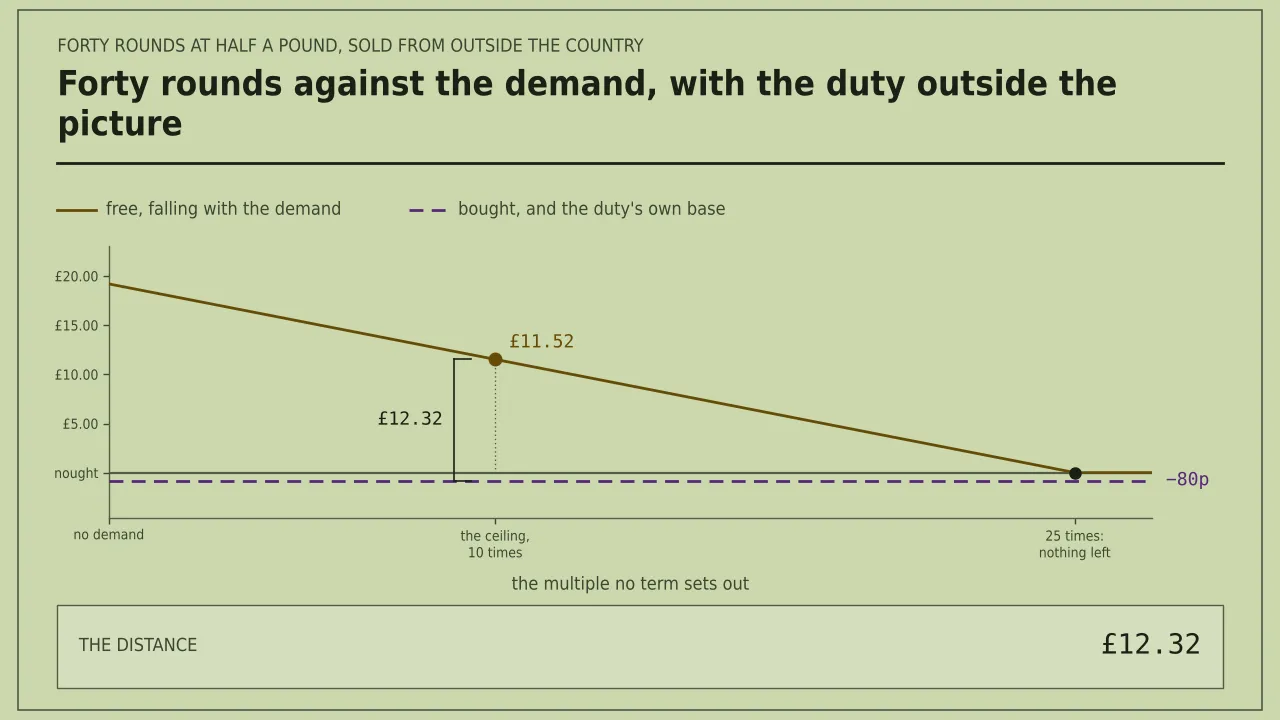
Forty rounds at 50p carry a face of £20.00 and land £19.20 of balance after the return has taken its margin. Ten times asked of £19.20 costs £7.68 and £11.52 stands. The same forty bought cost 80p in expectation with nothing owed on the winnings, so the findings are £12.32 apart, or 24.64 rounds. A statute reaches the provider wherever it sits, and a duty of 40 per cent follows the player home, while the protections do neither.
| What is being priced | Priced as a free round | Priced as a paid round | The gap between the two |
|---|---|---|---|
| Found before the first turn | nothing | £20.00 | £20.00 |
| Put over forty reels at 50p | £20.00 | £20.00 | none |
| Given back at the assumed return | £19.20 | £19.20 | none |
| Burnt clearing a ten-times demand | £7.68 | nothing owed | minus £7.68 |
| What it comes to | £11.52 | minus 80p | £12.32, or 24.64 rounds |
What the free round comes to £11.52 Forty turns at the cashier’s expense, £19.20 landing as balance, and three fifths of it outliving the heaviest demand a licence allows. What the paid round comes to minus 80p Forty half-pounds of the reader’s own, the margin being the only charge, and nothing whatever owed afterwards. The gap, in money and in rounds £12.32, 24.64 rounds The smaller figure taken from the larger, then the result counted out in half-pound turns.
Free rounds and what each asks in return
Paid placements are what these addresses are. A registration made through one brings this publisher a fee. Neither quote knows which address is which, and no figure on a bout would differ if it did.
-
01Free Play Arena
Betportal
Thirty-five times, three deposits
What the free side comes tonothing150 rounds at 10c, across a play-through of 35 timesWhat the same play costs paid forminus 60cthe identical play behind the reader's own stake, where the only cost is the return itself and no play-through is owedThe distance, in money and in rounds60cthe two findings subtracted, and the same distance said again as 6 rounds at the stake aboveOffered free
How the free side is pricedA count of rounds the offer stakesRounds counted150 roundsWorth of one round10cstated by this publisher, as a quantity of the money this offer is quoted in, no operator having valued a round of its ownCredited as a sumunpublishedCredit waiting on a paymentstated300% over three deposits, ceiling €1,000The face of it€15.00Rounds priced at the stake this publisher states, in the money this offer is quoted in, no operator having valued a round of its ownAsked in return
Play-through35 timesthe bonusCredited towards it100 per centno share has been published anywhere, so every penny counts, that being the kindest available reading of the silencePrices out above25 timesagainst the return assumed here and the share above, any play-through beyond this leaves the free quote worth nothing whateverCeiling on winningsstatedFive times the bonusLargest stake while it runs€5.00capping the stake closes off part of whatever range a lobby offers, and keeps it closed while the credit lastsQualifying payment€20.00200 rounds at the worth above, and no price here touches itOne play priced on both sides of the free line Priced step by step With the offer staking With the reader staking The distance What goes in first nothing minus €15.00 €15.00 What the staking hands back €14.40 €14.40 none What the play-through takes minus €20.16 nothing owed minus €20.16 What it comes to nothing minus 60c 60c, or 6 rounds The play-through asked here is at or past 25 times, the point where the condition costs more than it is laid against, so the free side comes to nothing whatever and the distance is the paid cost by itself.
No licence for Great Britain
Licence held in Anjouan, Comoros, by BetPortal Gaming Ltd, with Excite Ultra Media Ltd, under number ALSI-202601040-FI2.
Open the offer at Betportal, opens in a window of its own -
02Free Play Arena
WinBeast
Five deposits, with a free bet
What the free side comes tonothing500 rounds at 10c, across a play-through of 40 timesWhat the same play costs paid forminus €2.00the identical play behind the reader's own stake, where the only cost is the return itself and no play-through is owedThe distance, in money and in rounds€2.00the two findings subtracted, and the same distance said again as 20 rounds at the stake aboveOffered free
How the free side is pricedA count of rounds the offer stakesRounds counted500 roundsWorth of one round10cstated by this publisher, as a quantity of the money this offer is quoted in, no operator having valued a round of its ownCredited as a sumunpublishedCredit waiting on a paymentstated50% to 100% over five deposits, each ceiling €1,000, with a €650 free betThe face of it€50.00Rounds priced at the stake this publisher states, in the money this offer is quoted in, no operator having valued a round of its ownAsked in return
Play-through40 timesthe bonus and the winnings from the spinsCredited towards it100 per centno share has been published anywhere, so every penny counts, that being the kindest available reading of the silencePrices out above25 timesagainst the return assumed here and the share above, any play-through beyond this leaves the free quote worth nothing whateverCeiling on winningsstated€100 a batch of spinsQualifying payment€20.00200 rounds at the worth above, and no price here touches itOne play priced on both sides of the free line Priced step by step With the offer staking With the reader staking The distance What goes in first nothing minus €50.00 €50.00 What the staking hands back €48.00 €48.00 none What the play-through takes minus €76.80 nothing owed minus €76.80 What it comes to nothing minus €2.00 €2.00, or 20 rounds The play-through asked here is at or past 25 times, the point where the condition costs more than it is laid against, so the free side comes to nothing whatever and the distance is the paid cost by itself.
No licence for Great Britain
Licence held in Curaçao, behind a company the site declines to name.
Open the offer at WinBeast, opens in a window of its own -
03Free Play Arena
EliteSpin
Forty times, five deposits
What the free side comes tonothing500 rounds at 10p, across a play-through of 40 timesWhat the same play costs paid forminus £2.00the identical play behind the reader's own stake, where the only cost is the return itself and no play-through is owedThe distance, in money and in rounds£2.00the two findings subtracted, and the same distance said again as 20 rounds at the stake aboveOffered free
How the free side is pricedA count of rounds the offer stakesRounds counted500 roundsWorth of one round10pstated by this publisher, as a quantity of the money this offer is quoted in, no operator having valued a round of its ownCredited as a sumunpublishedCredit waiting on a paymentstated50% to 100% over five deposits, each ceiling £1,000The face of it£50.00Rounds priced at the stake this publisher states, in the money this offer is quoted in, no operator having valued a round of its ownAsked in return
Play-through40 timesthe bonus and the winnings from the spinsCredited towards it100 per centno share has been published anywhere, so every penny counts, that being the kindest available reading of the silencePrices out above25 timesagainst the return assumed here and the share above, any play-through beyond this leaves the free quote worth nothing whateverCeiling on winningsstatedFive times the bonusQualifying payment£20.00200 rounds at the worth above, and no price here touches itOne play priced on both sides of the free line Priced step by step With the offer staking With the reader staking The distance What goes in first nothing minus £50.00 £50.00 What the staking hands back £48.00 £48.00 none What the play-through takes minus £76.80 nothing owed minus £76.80 What it comes to nothing minus £2.00 £2.00, or 20 rounds The play-through asked here is at or past 25 times, the point where the condition costs more than it is laid against, so the free side comes to nothing whatever and the distance is the paid cost by itself.
No licence for Great Britain
Licence held in Costa Rica, by PrimeTier Limited.
Open the offer at EliteSpin, opens in a window of its own -
04Free Play Arena
Nightluck
No play-through published
What the free side comes toNOT STRUCKNot struck in full, for want of the count of rounds this offer puts up.What the same play costs paid forNOT STRUCKNot struck in full, for want of the count of rounds this offer puts up.The distance, in money and in roundsUNPRICEDone of the two sides is short of a figure, so nothing is subtracted here and nothing is struckOffered free
How the free side is pricedA count of rounds the offer stakesRounds countedunpublishedWorth of one round10pstated by this publisher, as a quantity of the money this offer is quoted in, no operator having valued a round of its ownCredited as a sumunpublishedCredit waiting on a paymentstated100% of the first deposit, ceiling £300The face of itunpublishedAsked in return
Play-throughunpublishedThe offer page sends a reader to the terms for the multiple and prints no figure itselfCredited towards it100 per centno share has been published anywhere, so every penny counts, that being the kindest available reading of the silencePrices out above25 timesagainst the return assumed here and the share above, any play-through beyond this leaves the free quote worth nothing whateverCeiling on winningsunpublishedQualifying payment£10.00100 rounds at the worth above, and no price here touches itNot struck in full, for want of the count of rounds this offer puts up.
No licence for Great Britain
The site names no jurisdiction for its licence, behind a company the site declines to name.
Terms read 22 October 2026
Open the offer at Nightluck, opens in a window of its own
Three quantities on a bout were worked out here. Everything else was transcribed. The free quote comes off E = B × (1 − W × (1 − RTP) ∕ g), where W is whatever play-through the terms demand, g is the proportion of a qualifying stake that counts towards it, RTP is the return assumed of an ordinary slot, and B is whatever is left standing by the time the condition applies. A batch of rounds surrenders part of itself before that point, every round having staked its value and taken the return against it, while a credited sum surrenders nothing at all yet, nothing having gone through the machine. Past break-even the charge exceeds whatever it is charged against, and the free quote settles at nothing rather than below it, nothing being removable beyond what turned up.
The paid side is cost = N × s × (1 − RTP), and it is the figure that makes this bill different from every other ranking in this network. The identical count of rounds at the identical stake, with the reader's own money behind them, hands the margin over once and owes nothing afterwards, there being no credit to turn over and no ceiling to come under. So the two sides are not two readings of one offer. They are one play at two prices, and the distance between them is what the word free is worth on that bout, said as a sum and said again as a count of rounds, because a reader counts in rounds and pays in money.
Read the reckoning downwards and the distance column adds up to the finding. It opens at whatever the paid side has to put in before a round turns, loses whatever the free side gives up that the paid side does not, and closes at the answer, so the bout can be checked without any of it being worked again. A step where both sides move alike leaves the distance reading none, which says the return treats the two the same way there and the distance is made somewhere else.
On a bout whose free half is a demo, both of its own figures are nought and neither one is approximate. Cash has no route out of a demo, so a demo balance showing five hundred pounds settles at nought, and the distance comes out at exactly what buying the rounds costs. Those noughts are findings rather than figures somebody held back. Where a figure really is absent, one of three words takes its place instead. Stated means a condition written out in sentences, which costs something and offers nothing to subtract. Unpublished means a condition written down nowhere whatever. Unpriced means a count published clearly enough, with nothing anywhere putting a value on one of them. None of the three conceals an approximation, and nobody here is credited with a figure they never supplied.
Two figures on every bout belong to this publisher and are stated rather than read. The return both sides are worked at is a general industry figure for an ordinary slot: it is an assumption of this publisher's, it is not read off any title or off anybody who builds one, and a line that spends it says so where it spends it. The worth of one round is the other, and it is spent only where no operator has put a worth on one of its own, nobody publishing a minimum or a maximum for that and no rule setting either. Every bout spending that figure prints whose figure it is. Everything else in a bout was quoted out of an operator's own terms on the day recorded at its foot.
Four duties written by a Great Britain licence come down on the free column of a bout. None of the four comes down on the paid column, because nothing is advanced there for a condition to attach itself to, and that lopsidedness is the argument of the whole bill. Limb 3(a) of Social Responsibility Code 5.1.1 took effect on 19 January 2026 and forbids a holder to ask that bonus funds be played through more than ten times over. Read the play-through term above against that: anything beyond ten times is a term no British holder could have published. Whether a free round counts as bonus funds for the purposes of that limit has not been published in either direction, so this publisher asserts neither reading of it. Statutory Instrument 2025 No. 215, made on 25 February 2025, inserted regulation 5(2), under which no individual may stake more than £5 on a single game cycle of an online slot, falling to £2 under the age of 25. That limit fastens itself to the operating licence rather than to any game, so beyond the licence a lobby offers whatever stake range it pleases with nothing standing over the top of it. Requirement 3C of the remote technical standards obliges a holder to make the rules of a game available before anybody commits money to it. Both quotes above rest on an assumed return rather than a published one, and that duty is the reason an assumption is needed at all out here. Membership of Gamstop Online is a condition of holding the British licence, so the scheme stretches exactly as far as the licence stretches and no further. An offer licensed beyond it sits outside by construction, and a registration somebody has already completed does not reach this offer. Free and confidential help is on the National Gambling Helpline, 0808 8020 133, answering 24 hours a day on every day of the year.
Any condition quoted on a bout appears in the words of whoever published it, and every bout states the day somebody read it. The furthest back of those days on this bill is 22 October 2026. What binds a reader is an operator's own terms, entire, and never a line of this.
1
Forty free rounds at half a pound, and what the £19.20 meets
Forty turns, half a pound on each a stake this bill picks, send £20.00 through the reels. Throughout this bill the return is 96 per cent, which is what an ordinary slot is taken to give back here and is not read off any named game a return this bill picks, so £19.20 comes home and settles as balance. The reader has staked none of it. The £20.00 belongs to whoever fronted the rounds, and the £19.20 is a number in the reader’s column waiting for a term to be applied to it.
The term is priced by E = B × (1 − W × (1 − RTP) ∕ g). The letters read out: B the £19.20 of balance, W the multiple, RTP the return, g how much of a stake a qualifying title is credited with. Ten times at full credit leaves three fifths of the £19.20, which is £11.52, and the missing £7.68 is what £192.00 of turnover costs where four pence in each pound stays behind.
| What is demanded | Turnover it comes to | What £19.20 is reduced to |
|---|---|---|
| Five times | £96.00 | £15.36 |
| Ten times | £192.00 | £11.52 |
| Twenty times | £384.00 | £3.84 |
| Twenty-five times | £480.00 | nothing |
£11.52 out of £19.20 is the floor rather than the middle of a range, since no British licence may demand more than ten times the funds advanced rule sheet, claims 58 and 91, a bound in force since January 2026. Read the table upwards and the reason is plain: five times leaves £15.36, so a lighter term is always a larger figure, and the heaviest lawful demand is the one a published number exists for. No cashier answering to this key holds such a licence, so for these offers the four rows above have nothing over them and nothing under them.
An offer of this description is fronted by somebody holding neither a Great Britain licence nor anything that stands in for one, and three duties of that licence price out against the figures above. A licensed game has to make the information a customer needs about their chances easily available before they commit to play rule sheet, claim 120, which is worth the 96 per cent this whole bill rests on: without that duty the return is a figure this publisher states and nobody is answerable for. The ten-times bound is the second, worth the entire £11.52. The third is the national scheme, whose membership travels with the British licence rule sheet, claim 181, and whose own terms disclaim any power over a business that has not joined it rule sheet, claim 183.
2
The same forty bought at fifty pence a turn
Run the forty again with the reader buying each turn. £20.00 goes across the reels, £19.20 comes back, and 80p is the difference. That 80p is the entire cost of the forty and there is no second entry beside it. Nobody advanced anything, so the winnings carry no obligation at all, and a ceiling on a multiple is irrelevant to a column with no multiple in it.
£11.52 against 80p is a distance of £12.32, or 24.64 rounds more at 50p apiece. The fraction is kept because it is what the division gives, and tidying it to twenty-five rounds would quietly add 18p of invention to a figure taken off a sum.
The paid column also happens to be the one quantity on this bill that a tax officer has an interest in, which is the subject of part four. For now it is enough to notice that 80p is not merely the reader’s cost. It is also, to the penny, what the forty rounds earn whoever sold them, since the stakes received less the winnings paid out is the same subtraction read from the other side of the counter.
forty rounds worth £11.52 free and 80p to buy, £12.32 between the two, which is 24.64 rounds at 50p
3
How far the Act reaches, and whom it is written about
A key beginning with the word non invites a reader to think the British rulebook stops at the coast. On the licensing question it does not, and the way it does not is worth setting out carefully, because the detail decides what this page may and may not say next.
| What the Act settles | The reading | Where it comes from |
|---|---|---|
| The offence itself | providing facilities without a licence | claim 1, section 33 |
| What it carries | up to 51 weeks, a fine, or both | claim 2, section 33 |
| Whether location matters | immaterial, inside the country or out | claim 4, section 36 |
| What brings it home | equipment here, or facilities used here | claim 4, section 36 |
| The test on the second limb | knowing, or being in a position to know | claim 5, section 36 |
That arrangement has a date on it. The two subsections were put in by an Act of 2014 and took effect on 1 November 2014 rule sheet, claim 6, and before then the offence reached remote gambling only where the equipment itself stood in Great Britain. So the rule a reader is meeting is a dozen years old and was a deliberate change of reach rather than an accident of drafting.
Now the limit, and it matters more than the reach. Section 33 is addressed to whoever supplies the facilities, and the Act makes no companion offence out of being the customer rule sheet, claim 3. That is a precise thing and it is also the end of it. It does not follow that playing where no licence is held carries no cost, and this bill has spent two parts measuring what the cost is: £11.52 of balance exposed to a demand nobody prints, held by somebody under no duty to say how they hold it. What a reader stands to lose here is protection and not liberty, and the two are easy to confuse because only one of them has a statute written about it.
Advertising is a separate offence with its own section, and it carries its own tests about whether the advertiser knew the gambling was unlawful rule sheet, claims 7 and 8. Worth knowing only because a reader seeing such an offer promoted may reasonably wonder whether anybody minds, and the answer is that the statute minds about the promoter too.
4
Thirty-two pence of the eighty, and whose debt that is
Here is the sharpest figure on this bill, and it comes out of the paid column rather than the free one. Of the 80p in part two, 32p is British duty. The charge falls on what the seller clears and not on what the reader stakes, and over these forty rounds the two are the same number: £20.00 taken in, £19.20 paid back out rule sheet, claim 172. The rate on or after 1 April 2026 is 40 per cent rule sheet, claim 173, so 32p of the 80p is duty and 48p is the seller’s.
Two features of the 32p matter more than its size. It is the operator’s debt and not the reader’s, the guidance speaking to the operator from end to end and describing nothing payable by a player rule sheet, claim 172. And its reach is fixed by where the player normally lives rather than by where the operator is licensed, so a seller abroad that takes a British player’s stake falls inside the charge with or without a British licence rule sheet, claim 174.
| The rate and when it applied | Taken from £80.00 of provider profit |
|---|---|
| 40 per cent, from April 2026 | £32.00 |
| 21 per cent, from April 2019 | £16.80 |
| 15 per cent, in the years before | £12.00 |
A hundred readers, each buying forty rounds at 50p, hand a seller £80.00 of profit between them, so those three rows are what the Exchequer would take from the identical play at three points in the past decade rule sheet, claim 173. The newest step very nearly doubles it, which is a fact about public finance and not about any offer.
Set that beside the two findings of this bill and the shape comes out. The duty follows the reader: it is owed because of where the reader lives, and owed whatever licence the seller holds. The protections run the other way, every one of those in part one being a condition of a licence, so not one of them travels with anybody. One claim crosses the water after a British player and the other stays behind, and a key beginning with non names the position where that gap is widest.
The reader’s own tax position is a separate question and this bill will not stretch it. The revenue’s published view is that gambling of itself constitutes no trade, which is why a win is not trade income rule sheet, claims 169 and 171, and a 1925 judgment carries the court’s remark that a habit goes untaxed rule sheet, claim 170. No official page was found declaring winnings untaxed in terms rule sheet, claim 175, so this bill reports the published position and goes no further. Nothing here speaks to anybody’s own circumstances.
5
What follows a reader home, and what stays with the licence
Part four left a question open: if the duty travels and the protections do not, what is it that stays behind. The regulator has published an answer, and it is broader than a reader expects. Four losses, not one, and only the first of the four touches arithmetic.
| What is lost | What the notice records |
|---|---|
| Controls on harm and on dirty money | they may be inadequate |
| Protection from fraud | a risk left open to customers |
| Privacy of personal data | named outright as a problem |
| Fair dealing | unfair practices, with the vulnerable sought out |
Dated the twentieth of January 2025, that notice has published money standing behind it rule sheet, claim 130. A games supplier agreed £4.75m on 23 July 2026, six unlicensed sites reachable from Great Britain having carried its games rule sheet, claim 132. Hold £4.75m against the £12.32 this bill has been measuring and the scale is the argument: the larger figure is the price of one supply chain going wrong, the smaller is one reader’s forty rounds, and both are real.
It would be easy and wrong to close by saying nothing at all exists outside the British licence. What the sources support is narrower. One European authority runs a formal complaints route with a published form, and what that route leaves unsaid matters as much as the route rule sheet, claims 163 and 164.
| What a reader would want to know | What the page states |
|---|---|
| How long there is to complain | no limit given |
| Whether residence matters | no rule given |
| What the body can actually do | its powers not described |
| Whether a ruling binds a seller | not stated either way |
Elsewhere it is worse than unclear. For one jurisdiction these sites often cite, no regulator’s own material could be located rule sheet, claim 166; for another, the official pages failed to load on the day they were tried rule sheet, claim 167. A rulebook nobody can read is not a rulebook a reader can rely on, and this publication will not describe one it has not seen.
So the honest reading of the non in this key is not a crossing into lawlessness. It is a crossing into a place where the duties priced in part one do not apply, where what does still apply is a tax charged to somebody else, and where the rulebook taking Britain’s place may be published, may be unreachable, or may never have been found. The £11.52 sits there. The 80p does not.
6
The weighting, and the figures no source would supply
The fourth letter in the expression is the one that moves the answer most and the one least often printed. A stake on a qualifying game may be credited in full against a demand or at a part of its value, and a share as low as 30p in the pound is inside what the rules allow rule sheet, claim 96. This bill credits stakes in full, which is the reading most favourable to the figure it produces, and that choice is printed here beside the figure it affects.
A weighting of 30p in the pound empties the £11.52 outright. Ten times £19.20 owes £192.00, which at 30p needs £640.00 turned over and costs £25.60, more than the balance holds. E stops at nothing, nobody being able to fall into debt over money they never put in. At 50p in the pound the same £192.00 wants £384.00 of turnover at a cost of £15.36, so £3.84 survives rather than £11.52. A single unprinted percentage therefore takes £7.68 off this page’s free figure without the multiple changing at all.
| How a qualifying stake is credited | Turnover wanted | What is left of £19.20 |
|---|---|---|
| In full | £192.00 | £11.52 |
| At half value | £384.00 | £3.84 |
| At three tenths of a pound | £640.00 | nothing |
Nowhere in the material read for this bill is there a figure for what a cashier outside Great Britain demands in turnover. Nor one for how it credits a qualifying stake, nor for the sum below which it declines to pay out. Three silences, and they are the reason the sums lean on a British number, which is named as a ceiling in each sentence that spends it: the most a licence permits anybody to ask, binding a licensee and binding none of the offers this key describes. £12.32 is therefore the narrowest the two findings come apart and the least these forty rounds beat buying the same forty by. Away from the licence nothing lawfully bounds the distance at either end, and £12.32 is a figure this publisher has elected to stand on rather than a limit imposed on anybody.
7
A demo priced the same way, and the noughts it returns
A demo is the one play this publication prices without subtracting anything. No money leaves a demo balance whatever it displays, because no mechanism for money leaving one exists: not a reduced payout, not a payout somebody has hedged, and not a number withheld from print. Both sides of the instrument read nought and so does the distance, and all three are results in their own right, not blanks.
The demo also settles the question this key raises more neatly than any argument. A demo balance is beyond the reach of every rulebook on earth, British or otherwise, and it is worth nothing anywhere. What makes a real balance worth more than a demo one is not the number on the screen but the arrangement for turning that number into money, and this bill has spent five parts showing which of those arrangements travel with a reader and which do not. The 80p in the paid column is the only figure here that needed none of them.
Questions
- What do 40 free rounds come to at a cashier outside Britain
- £11.52, worked on the British ceiling of ten times, with no bounded figure available where that licence is not held. £20.00 of face at 50p a turn lands £19.20 of balance at the return used here, the ten-times demand costs £7.68, and twenty-five times would consume the balance.
- What do the same 40 rounds cost if the reader pays for them
- 80p in expectation. £20.00 is staked and £19.20 comes back, so 80p is the whole margin over forty half-pound turns. No credit was advanced and nothing is owed on the winnings, so no multiple touches the figure.
- Does the Gambling Act reach an operator based abroad
- On the licensing question, yes. The Act makes the operator’s location immaterial and applies the offence where equipment stands here or where the facilities are used here, with the second limb turning on whether the provider knows or ought to know. That arrangement took effect on 1 November 2014.
- Is a player committing an offence by using such a site
- Section 33 is addressed to whoever supplies the facilities and the Act makes no companion offence out of being the customer. That is the whole of the point, though: what a reader loses here is protection rather than liberty, and this bill measures the loss at £11.52 of balance held by somebody under no published duty.
- How much British tax is in the 80p
- 32p of it. Remote gaming duty is charged on the provider’s profit, which is stakes received less winnings paid, and on these forty rounds that is exactly the 80p. The rate on or after 1 April 2026 is 40 per cent, so 32p is duty and 48p is the provider’s.
- Does the duty still apply if the operator has no British licence
- Yes. Its reach is fixed by where the player normally lives and not by where the operator is licensed, so a seller abroad that takes a British player’s stake falls inside the charge either way. It is the operator’s debt, and the guidance names nothing payable by a player.
- Why does this bill work the free side at ten times
- No source read for it prints the multiple a cashier of this kind asks, the credit it gives a qualifying stake, or the sum under which it will not pay. Ten times is the only cap anybody publishes, and being the heaviest lawful demand it gives the smallest free figure, so £12.32 is the least these forty beat buying them by rather than a typical result.
- Is there really nothing in place outside the British licence
- No, and saying so would be false. One European authority runs a formal complaints route with a published form, and states no time limit, no residency rule, nothing about its own powers and nothing about whether a ruling binds a seller. For one commonly cited jurisdiction no regulator’s own material could be found at all, and for another the official pages could not be reached.