Figures read 26 October 2026 Bill U02, first printing
Slots not on Gamstop: nothing holds a spin to 2.5 seconds, and 25 free rounds come to £1.44
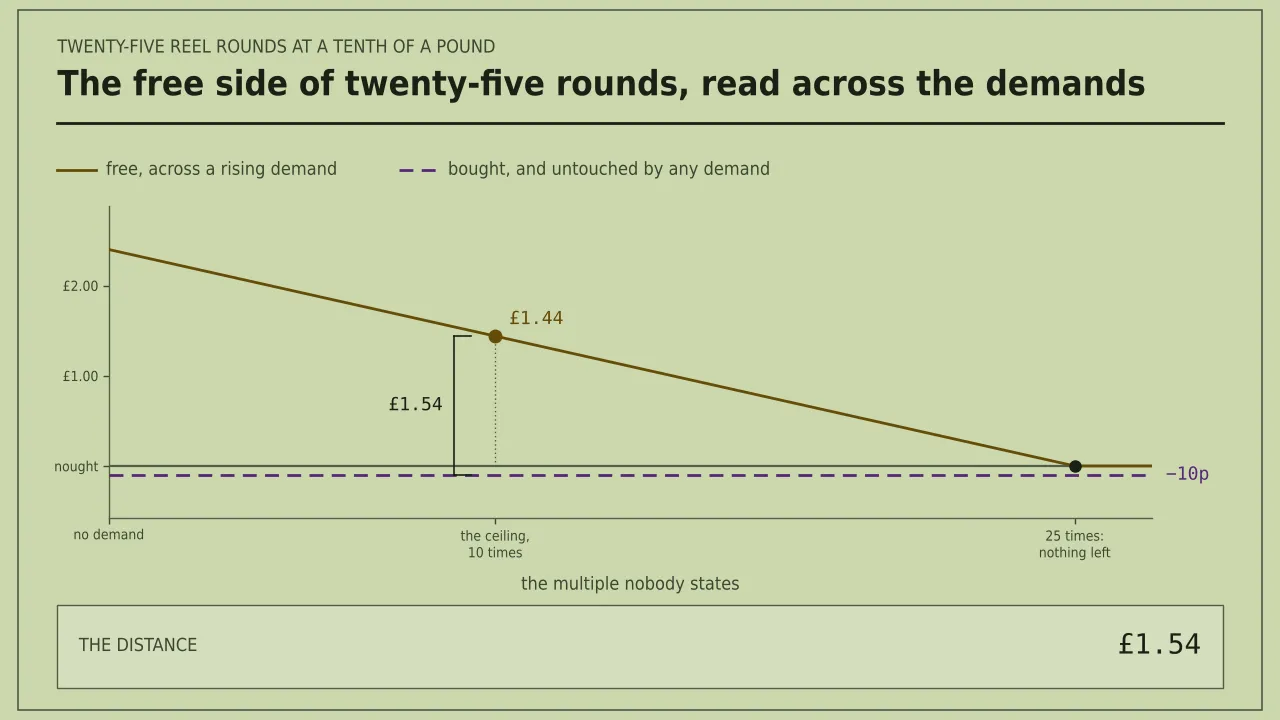
Twenty-five rounds at 10p, the stake this bill assumes, show a face of £2.50 and land £2.40 once a 96 per cent industry-wide return is applied. Ten times demanded of that balance takes 96p and leaves £1.44. Buying the same twenty-five costs 10p in expectation, with nothing owed behind the winnings, so £1.54 separates the two findings and that is 15.4 rounds at the same stake. Where no register reaches, two floors under the machine go with the bound on the multiple: no least interval between rounds, and no bar on a game adjusting the odds it runs on, which is the thing the 96 per cent was leaning against.
| What is being priced | Priced as a free round | Priced as a paid round | The gap between the two |
|---|---|---|---|
| Put in before a reel turns | nothing | £2.50 | £2.50 |
| Staked by twenty-five rounds | £2.50 | £2.50 | none |
| Handed back at 96 per cent | £2.40 | £2.40 | none |
| Consumed by a ten-times demand | 96p | nothing owed | minus 96p |
| What it comes to | £1.44 | minus 10p | £1.54, or 15.4 rounds |
What the free round comes to £1.44 A £2.40 balance arrives without a deposit, ten times is demanded of it, and 96p of the balance pays for the demand. What the paid round comes to minus 10p Twenty-five reels turned on the reader’s own money, costing only what the return keeps and owing nothing after. The gap, in money and in rounds £1.54, 15.4 rounds The difference the two sums leave, converted back into rounds at 10p apiece.
Free rounds and what each asks in return
Paid placements are what these addresses are. A registration made through one brings this publisher a fee. Neither quote knows which address is which, and no figure on a bout would differ if it did.
-
01Free Play Arena
Betportal
Thirty-five times, three deposits
What the free side comes tonothing150 rounds at 10c, across a play-through of 35 timesWhat the same play costs paid forminus 60cthe identical play behind the reader's own stake, where the only cost is the return itself and no play-through is owedThe distance, in money and in rounds60cthe two findings subtracted, and the same distance said again as 6 rounds at the stake aboveOffered free
How the free side is pricedA count of rounds the offer stakesRounds counted150 roundsWorth of one round10cstated by this publisher, as a quantity of the money this offer is quoted in, no operator having valued a round of its ownCredited as a sumunpublishedCredit waiting on a paymentstated300% over three deposits, ceiling €1,000The face of it€15.00Rounds priced at the stake this publisher states, in the money this offer is quoted in, no operator having valued a round of its ownAsked in return
Play-through35 timesthe bonusCredited towards it100 per centno share has been published anywhere, so every penny counts, that being the kindest available reading of the silencePrices out above25 timesagainst the return assumed here and the share above, any play-through beyond this leaves the free quote worth nothing whateverCeiling on winningsstatedFive times the bonusLargest stake while it runs€5.00capping the stake closes off part of whatever range a lobby offers, and keeps it closed while the credit lastsQualifying payment€20.00200 rounds at the worth above, and no price here touches itOne play priced on both sides of the free line Priced step by step With the offer staking With the reader staking The distance What goes in first nothing minus €15.00 €15.00 What the staking hands back €14.40 €14.40 none What the play-through takes minus €20.16 nothing owed minus €20.16 What it comes to nothing minus 60c 60c, or 6 rounds The play-through asked here is at or past 25 times, the point where the condition costs more than it is laid against, so the free side comes to nothing whatever and the distance is the paid cost by itself.
No licence for Great Britain
Licence held in Anjouan, Comoros, by BetPortal Gaming Ltd, with Excite Ultra Media Ltd, under number ALSI-202601040-FI2.
Open the offer at Betportal, opens in a window of its own -
02Free Play Arena
WinBeast
Five deposits, with a free bet
What the free side comes tonothing500 rounds at 10c, across a play-through of 40 timesWhat the same play costs paid forminus €2.00the identical play behind the reader's own stake, where the only cost is the return itself and no play-through is owedThe distance, in money and in rounds€2.00the two findings subtracted, and the same distance said again as 20 rounds at the stake aboveOffered free
How the free side is pricedA count of rounds the offer stakesRounds counted500 roundsWorth of one round10cstated by this publisher, as a quantity of the money this offer is quoted in, no operator having valued a round of its ownCredited as a sumunpublishedCredit waiting on a paymentstated50% to 100% over five deposits, each ceiling €1,000, with a €650 free betThe face of it€50.00Rounds priced at the stake this publisher states, in the money this offer is quoted in, no operator having valued a round of its ownAsked in return
Play-through40 timesthe bonus and the winnings from the spinsCredited towards it100 per centno share has been published anywhere, so every penny counts, that being the kindest available reading of the silencePrices out above25 timesagainst the return assumed here and the share above, any play-through beyond this leaves the free quote worth nothing whateverCeiling on winningsstated€100 a batch of spinsQualifying payment€20.00200 rounds at the worth above, and no price here touches itOne play priced on both sides of the free line Priced step by step With the offer staking With the reader staking The distance What goes in first nothing minus €50.00 €50.00 What the staking hands back €48.00 €48.00 none What the play-through takes minus €76.80 nothing owed minus €76.80 What it comes to nothing minus €2.00 €2.00, or 20 rounds The play-through asked here is at or past 25 times, the point where the condition costs more than it is laid against, so the free side comes to nothing whatever and the distance is the paid cost by itself.
No licence for Great Britain
Licence held in Curaçao, behind a company the site declines to name.
Open the offer at WinBeast, opens in a window of its own -
03Free Play Arena
EliteSpin
Forty times, five deposits
What the free side comes tonothing500 rounds at 10p, across a play-through of 40 timesWhat the same play costs paid forminus £2.00the identical play behind the reader's own stake, where the only cost is the return itself and no play-through is owedThe distance, in money and in rounds£2.00the two findings subtracted, and the same distance said again as 20 rounds at the stake aboveOffered free
How the free side is pricedA count of rounds the offer stakesRounds counted500 roundsWorth of one round10pstated by this publisher, as a quantity of the money this offer is quoted in, no operator having valued a round of its ownCredited as a sumunpublishedCredit waiting on a paymentstated50% to 100% over five deposits, each ceiling £1,000The face of it£50.00Rounds priced at the stake this publisher states, in the money this offer is quoted in, no operator having valued a round of its ownAsked in return
Play-through40 timesthe bonus and the winnings from the spinsCredited towards it100 per centno share has been published anywhere, so every penny counts, that being the kindest available reading of the silencePrices out above25 timesagainst the return assumed here and the share above, any play-through beyond this leaves the free quote worth nothing whateverCeiling on winningsstatedFive times the bonusQualifying payment£20.00200 rounds at the worth above, and no price here touches itOne play priced on both sides of the free line Priced step by step With the offer staking With the reader staking The distance What goes in first nothing minus £50.00 £50.00 What the staking hands back £48.00 £48.00 none What the play-through takes minus £76.80 nothing owed minus £76.80 What it comes to nothing minus £2.00 £2.00, or 20 rounds The play-through asked here is at or past 25 times, the point where the condition costs more than it is laid against, so the free side comes to nothing whatever and the distance is the paid cost by itself.
No licence for Great Britain
Licence held in Costa Rica, by PrimeTier Limited.
Open the offer at EliteSpin, opens in a window of its own -
04Free Play Arena
Nightluck
No play-through published
What the free side comes toNOT STRUCKNot struck in full, for want of the count of rounds this offer puts up.What the same play costs paid forNOT STRUCKNot struck in full, for want of the count of rounds this offer puts up.The distance, in money and in roundsUNPRICEDone of the two sides is short of a figure, so nothing is subtracted here and nothing is struckOffered free
How the free side is pricedA count of rounds the offer stakesRounds countedunpublishedWorth of one round10pstated by this publisher, as a quantity of the money this offer is quoted in, no operator having valued a round of its ownCredited as a sumunpublishedCredit waiting on a paymentstated100% of the first deposit, ceiling £300The face of itunpublishedAsked in return
Play-throughunpublishedThe offer page sends a reader to the terms for the multiple and prints no figure itselfCredited towards it100 per centno share has been published anywhere, so every penny counts, that being the kindest available reading of the silencePrices out above25 timesagainst the return assumed here and the share above, any play-through beyond this leaves the free quote worth nothing whateverCeiling on winningsunpublishedQualifying payment£10.00100 rounds at the worth above, and no price here touches itNot struck in full, for want of the count of rounds this offer puts up.
No licence for Great Britain
The site names no jurisdiction for its licence, behind a company the site declines to name.
Terms read 22 October 2026
Open the offer at Nightluck, opens in a window of its own
Three quantities on a bout were worked out here. Everything else was transcribed. The free quote comes off E = B × (1 − W × (1 − RTP) ∕ g), where W is whatever play-through the terms demand, g is the proportion of a qualifying stake that counts towards it, RTP is the return assumed of an ordinary slot, and B is whatever is left standing by the time the condition applies. A batch of rounds surrenders part of itself before that point, every round having staked its value and taken the return against it, while a credited sum surrenders nothing at all yet, nothing having gone through the machine. Past break-even the charge exceeds whatever it is charged against, and the free quote settles at nothing rather than below it, nothing being removable beyond what turned up.
The paid side is cost = N × s × (1 − RTP), and it is the figure that makes this bill different from every other ranking in this network. The identical count of rounds at the identical stake, with the reader's own money behind them, hands the margin over once and owes nothing afterwards, there being no credit to turn over and no ceiling to come under. So the two sides are not two readings of one offer. They are one play at two prices, and the distance between them is what the word free is worth on that bout, said as a sum and said again as a count of rounds, because a reader counts in rounds and pays in money.
Read the reckoning downwards and the distance column adds up to the finding. It opens at whatever the paid side has to put in before a round turns, loses whatever the free side gives up that the paid side does not, and closes at the answer, so the bout can be checked without any of it being worked again. A step where both sides move alike leaves the distance reading none, which says the return treats the two the same way there and the distance is made somewhere else.
On a bout whose free half is a demo, both of its own figures are nought and neither one is approximate. Cash has no route out of a demo, so a demo balance showing five hundred pounds settles at nought, and the distance comes out at exactly what buying the rounds costs. Those noughts are findings rather than figures somebody held back. Where a figure really is absent, one of three words takes its place instead. Stated means a condition written out in sentences, which costs something and offers nothing to subtract. Unpublished means a condition written down nowhere whatever. Unpriced means a count published clearly enough, with nothing anywhere putting a value on one of them. None of the three conceals an approximation, and nobody here is credited with a figure they never supplied.
Two figures on every bout belong to this publisher and are stated rather than read. The return both sides are worked at is a general industry figure for an ordinary slot: it is an assumption of this publisher's, it is not read off any title or off anybody who builds one, and a line that spends it says so where it spends it. The worth of one round is the other, and it is spent only where no operator has put a worth on one of its own, nobody publishing a minimum or a maximum for that and no rule setting either. Every bout spending that figure prints whose figure it is. Everything else in a bout was quoted out of an operator's own terms on the day recorded at its foot.
Four duties written by a Great Britain licence come down on the free column of a bout. None of the four comes down on the paid column, because nothing is advanced there for a condition to attach itself to, and that lopsidedness is the argument of the whole bill. Limb 3(a) of Social Responsibility Code 5.1.1 took effect on 19 January 2026 and forbids a holder to ask that bonus funds be played through more than ten times over. Read the play-through term above against that: anything beyond ten times is a term no British holder could have published. Whether a free round counts as bonus funds for the purposes of that limit has not been published in either direction, so this publisher asserts neither reading of it. Statutory Instrument 2025 No. 215, made on 25 February 2025, inserted regulation 5(2), under which no individual may stake more than £5 on a single game cycle of an online slot, falling to £2 under the age of 25. That limit fastens itself to the operating licence rather than to any game, so beyond the licence a lobby offers whatever stake range it pleases with nothing standing over the top of it. Requirement 3C of the remote technical standards obliges a holder to make the rules of a game available before anybody commits money to it. Both quotes above rest on an assumed return rather than a published one, and that duty is the reason an assumption is needed at all out here. Membership of Gamstop Online is a condition of holding the British licence, so the scheme stretches exactly as far as the licence stretches and no further. An offer licensed beyond it sits outside by construction, and a registration somebody has already completed does not reach this offer. Free and confidential help is on the National Gambling Helpline, 0808 8020 133, answering 24 hours a day on every day of the year.
Any condition quoted on a bout appears in the words of whoever published it, and every bout states the day somebody read it. The furthest back of those days on this bill is 22 October 2026. What binds a reader is an operator's own terms, entire, and never a line of this.
1
Twenty-five free rounds, the face and the balance behind it
Twenty-five rounds has no price until a stake and a return are attached. This bill attaches 10p a round our stake, stated plainly and 96 per cent as an industry-wide return rather than a figure belonging to any title ours, not read off anything. Twenty-five tenpenny rounds make a face of £2.50. Apply the return and £2.40 lands as balance, with the £2.50 having come out of the cashier’s pocket and never the reader’s.
The formula for what survives a requirement reads E = B × (1 − W × (1 − RTP) ∕ g). Letters: B the balance landed by the rounds, W the multiple demanded, RTP the published return, g the qualifying share. Here B is £2.40, W ten, RTP 96 per cent, g full weight. The bracket comes to six tenths and £1.44 is what remains, so 96p of a £2.40 balance has gone on satisfying a demand rather than on anything a reader keeps.
Ten did not come off any offer. Britain will not let a wagering requirement exceed ten times the funds advanced; code 5.1.1 carries the bound and January 2026 is when it started to bite rule sheet, claims 58 and 91. It applies to licence holders. Ten times is the largest demand a British licence will carry, so a free column standing on it reads at its lowest lawful value. £1.44 sits at the bottom of the lawful range and not the top of it, and a smaller multiple would leave more of the £2.40 behind.
A cashier running slot rounds of this kind is regulated outside Great Britain, and the figures above lose three things at that boundary. The bound on the multiple is the first, and it is worth the difference between £1.44 and nought. Britain’s floor on the machine is the second: 2.5 seconds, start of one cycle to the start of the next, on a slot, with a deliberate act wanted at each start rule sheet, claim 107. That floor is why the ten-times demand on this bill has a least duration as well as a least turnover. The third is the bar on a game behaving adaptively, so that outcomes follow the probabilities the game was built on rather than probabilities altered while it runs rule sheet, claim 117. The third one is what the 96 per cent in every line above was leaning on.
2
The same twenty-five bought at 10p, and the column that never moves
Hand the cashier 10p for each of the twenty-five and the pricing is one line of subtraction. £2.50 staked, £2.40 returned at the rate assumed, 10p gone. That 10p is everything a 96 per cent return keeps across twenty-five tenpenny reels, and the reader owns the outcome outright, nothing having been advanced and nothing therefore being owed. No multiple stands over the winnings and no bound on a multiple is needed.
£1.54 wants a label, the figure inviting a wrong reading. It is a floor beneath the distance rather than a middle of it: the biggest demand a licence allows produces the tightest gap, so the free round is ahead by at least that much where the licence reaches. Away from the licence no figure bounds the demand upward or downward, so the £1.54 is this publisher’s stated choice of ground and not anybody’s obligation.
Together, then: £1.44 standing free, 10p of expected cost paid, £1.54 of distance, and £1.54 is 15.4 rounds at 10p. The second figure is the one the sibling publications on this key do not print, and without it the first figure is a number with nothing to lean against.
Carry the identical twenty-five across the boundary a register draws and the paid column holds absolutely still. 10p is 10p, because only the return sets it, and a return of 96 per cent keeps 4p in the pound wherever the reels happen to be spinning. Everything the register was protecting lived in the free column. So the free round is worth less where no register reaches, by the amount the ceiling was propping up, while the paid round costs an identical 10p on both sides of the line.
One more figure belongs here because readers ask for it in rounds rather than in pence. The distance of £1.54 spread across the count is 6.16p a round, which is 61.6 per cent of the stake, and it is the same proportion on any count at this return and this multiple. That is the compact form of the whole bill: at ten times and 96 per cent, a free round is worth a shade under 62 per cent of its stake more than the same round bought, and off the register the proportion has no floor under it.
twenty-five free rounds come to £1.44 under a borrowed ceiling, the same twenty-five cost 10p when bought, and £1.54 of distance is 15.4 more rounds at 10p
3
Ten times on £2.40, and the ten minutes a pace floor puts under it
Ten times £2.40 is £24.00 of turnover, and £24.00 at 10p a round is 240 rounds. Multiply out: 240 rounds, 2.5 seconds apiece, 600 seconds. A licensed slot cannot be made to clear that demand in under ten minutes, whatever anybody wants, because the interval between cycles is a floor and not a setting rule sheet, claim 107.
The demand costs 0.4p a round, so 240 rounds cost 96p, which is the fourth line of the instrument arrived at from the other end. Two routes to one figure is the useful kind of check: the formula gives 96p as the share of a £2.40 balance the bracket removes, and the round-by-round sum gives 96p as 4p in the pound of £24.00 turned over. Nothing in either route mentions a cashier, a jurisdiction or a register.
Take the floor away and the ten minutes is not a floor at all. The same 240 rounds can go through in whatever interval the machine allows, and the £24.00 of turnover with them. Nothing in the arithmetic shifts: £1.44 is still what the formula gives and 96p is still what the demand costs. What shifts is the number of minutes in which a reader meets that result, and the number of further decisions they take inside the same hour.
Twenty-five is where the balance dies: twenty-five times £2.40 is £60.00 of turnover, and 4p in the pound of £60.00 is £2.40 exactly. So the free column on this bill tops out at £1.44, bottoms out at nought somewhere before twenty-five times, and the figure choosing between the two is unprinted and unbounded once the licence goes. No primary source gives a distribution of multiples outside that licence rule sheet, claim 159, and this bill does not invent one.
| Demand on £2.40 | Turnover and rounds at 10p | Least time at the British floor |
|---|---|---|
| 10 times | £24.00, 240 rounds | 10 minutes |
| 25 times | £60.00, 600 rounds | 25 minutes |
| 60 times | £144.00, 1,440 rounds | 60 minutes |
4
An hour of reels with a floor under it, and £5.76 of ceiling
The pace floor converts into a cap on exposure, and the conversion is arithmetic rather than opinion. An hour is 3,600 seconds. Divided by 2.5 that allows 1,440 cycles, which at 10p apiece turn over no more than £144.00, and 4p of every pound turned over is £5.76. So £5.76 is the largest expected cost an hour of tenpenny reels can produce on a licensed machine, whatever anybody does with the start control.
That £5.76 is a real number with a published rule under it, and it is the clearest thing this page has to offer. It also explains why the bottom row of the table above runs to exactly an hour: sixty times £2.40 is £144.00, which is one hour of turnover at the British floor and the stake assumed here. A demand of sixty times, which is the multiple the regulator named when it set out what it was bounding rule sheet, claim 94, is therefore an hour of uninterrupted reels on a licensed machine and less than an hour anywhere the floor is missing.
Remove the floor and £5.76 stops being a ceiling of any kind. Two thousand cycles in an hour would turn over £200.00 and cost £8.00; four thousand would turn over £400.00 and cost £16.00. This bill states no cycle time for any cashier outside the British licence, because none is published, and the point needs no figure to land: an hourly ceiling computed from a least interval disappears entirely when the least interval does.
Britain writes that interval twice, at two lengths. A slot gets 2.5 seconds. Other casino games, with peer-to-peer poker set aside, get five seconds, and the longer one took effect on 17 January 2025 rule sheet, claims 108 and 114. The slot figure has no commencement date on the standard that carries it, so this bill prints the 2.5 seconds and attaches no date to it rule sheet, claim 109.
5
What a 96 per cent assumption is resting on, and where it stops resting
Every figure on this page past the £2.50 face depends on the 96 per cent, and the 96 per cent is this publisher’s assumption rather than a reading. On a licensed machine it has something under it: outcomes must be acceptably random, a game may not compensate, and interference with the probabilities is barred whether automatic or by hand rule sheet, claim 117. A second rule freezes the rules, the payouts and the probabilities once play has begun, and treats a term reserving the right to change them as unacceptable rule sheet, claim 118.
What a licensed site owes a player before they commit is narrower than it is usually reported to be. Four kinds of information will do and they are joined by or: how the game works and how prizes fall, a house edge, a return percentage, or how likely a winning event is rule sheet, claims 120 and 121. So no page may say a licence compels a return figure out of anybody, and this one does not say it. What the licence does compel is the honesty of whatever figure gets published, through the two bars in the paragraph above.
£1.44 came out of three inputs: a return of 96 per cent, a multiple of ten, a weighting of one. The multiple is borrowed from a British bound. The weighting is read at its most generous because nothing is printed, and the return is this publisher’s own. Away from the licence not one of the three carries a duty behind it, and that is this page’s finding rather than any single figure on it.
The weighting is worth one line of working, since it is the quickest way to empty the free column without touching the headline. Weighted at 30p in the pound, that £24.00 of required contribution becomes £80.00 of turnover, which costs £3.20 against a balance of £2.40 rule sheet, claim 96. The demand outruns the balance, E floors at nought, and nothing in that has passed the ceiling this bill stands on, which is the whole trick of a weighting. Where no contribution rate is printed, this bill reads g at full weight and says so at the line that spends it.
6
Six rules that shape a single round, every one of them licence-bound
Pace and randomness are two of a longer list, and the rest shape the inside of a round in ways no bonus headline mentions. The table sets six of them out beside what each is worth to the arithmetic above, which in five cases is nothing whatever, and the five noughts are the reason for printing it.
| What a British licence requires | What it stops | Worth to the £1.44 |
|---|---|---|
| a floor between cycles | a fresh round inside 2.5 seconds | sets the ten minutes |
| one cycle at a time | rounds beginning unbidden | nothing |
| no shortening the wait | turbo, quick spin, slam stop | nothing |
| one game at a time | split screens and parallel play | nothing |
| no dressed-up loss | a loss shown as a near miss | nothing |
| no cheered small return | 8p back on 10p marked a win | nothing |
Each row has a source on the rule sheet: the floor at claim 107, the bar on automatic play at claim 115, the bar on hurrying a result at claim 111, the bar on parallel games at claim 110, the near-miss bar at claim 116 and the celebration bar at claim 112 rule sheet, as cited. A seventh bars a product from pushing a player towards chasing a loss, or towards continuing once they have said they wish to finish, and it names the free game offered to somebody who has left rule sheet, claim 113, which is the one of the set that bears directly on the subject of this publication.
Five noughts down the right-hand column are the finding of this part. Those rules change no figure above; they change how many rounds get played and what the machine does next. A free round is what brings somebody to the machine, and the machine is where the money is settled. Treating the count as the whole offer is the mistake this publication prices, and on a slot key the machine’s rulebook answers more of the question than the count does.
The absence is not that the machine meets a weaker standard. It is that no document exists for a British reader to hold it to, so the figures above are the best available reading wearing exact decimals. That distinction is worth more than any adjective: a standard a reader can open and a standard nobody has published are different kinds of thing, not two points on one scale.
7
Demo reels at nought, and the two statutory stake figures
Twenty-five demo rounds cost nought and return nought. No mechanism carries money out of a demo, so a demo reading of £500.00 is not a sum anybody can be paid. The second nought is structural rather than cautious: no thin return, no conditional return, no withheld figure. Both halves of a demo sum are nought and neither of them is an approximation.
Where the free side is a demo, every line of the free column reads nought and the distance column matches the paid column all the way down, 10p in this instance. That settles the site’s own question for the case. A version that pays nothing by construction says nothing whatever about a version that hands back 96 per cent of its turnover, so time in a demo lobby buys familiarity with a layout and prices precisely nothing.
| Stake per cycle | Where the figure comes from | Face of twenty-five rounds |
|---|---|---|
| 10p | this bill’s own assumption | £2.50 |
| £2 | statutory cap, player under 25 | £50.00 |
| £5 | statutory cap, player 25 or over | £125.00 |
Regulations made in February 2025 fixed those statutory figures, the higher of them live from 9 April and the lower from 21 May that year, and neither reaches any casino game outside the slot definition rule sheet, claims 124 to 127. Scale the bill to the £5 row and every line multiplies by fifty: £120.00 of balance, £48.00 taken by ten times, £72.00 standing free, £5.00 for the same count bought. The ratio between the columns never moves, which is the useful part. The stake sizes the bill and the multiple decides it.
Both caps stop where the licence stops, which leaves the 10p on this page in an odd position: a figure this publisher chose, well under either of them. A cashier beyond the caps can set a cycle stake wherever it likes, and a free round’s face then says as little about the exposure that follows as the count does. Scale the same twenty-five rounds to a £1 stake and the face is £25.00, the balance £24.00, the ten-times demand £9.60 and the free side £14.40, against £1.00 for the purchase. Ten times the stake is ten times every line, and the count on the banner has not changed by one round.
That is the last thing a free round hides. A reader comparing counts is comparing the one quantity a cashier can print without committing itself to anything, while the stake, the multiple and the weighting between them settle what the count is worth. Two of those three are unprinted at any cashier beyond the register, and the third is bounded only where a licence binds it.
8
The figures gathered, and what has gone missing around them
Gathered: £2.50 of face, £2.40 of balance, 96p to a ten-times demand, £1.44 free, 10p paid, £1.54 of distance, 15.4 rounds. Beside them three time figures: ten minutes to clear ten times, twenty-five minutes to clear twenty-five, and £5.76 as the most an hour of this stake costs where a floor exists.
A free round on a slot the register cannot reach is worth less than the same round where it can, short by the £1.44 a borrowed bound props up, while the purchase costs 10p either way. Particular to slots, the machine loses its own floors too, and five of those cost the arithmetic nothing while changing everything about the hour in which it plays out.
The absences, each with a source behind it: the cycle floor; automatic play barred; the wait never shortened; parallel games barred; a loss never dressed as a near miss; a small return left uncheered; no compensated game; rules and payouts frozen once play starts; two statutory stake caps; a bound of ten on a requirement; identity settled before any play, bonus play included rule sheet, claim 18; and the scheme itself, whose reach follows the licence rule sheet, claim 181 and whose terms concede that gambling run from outside it is past anything it can shut off rule sheet, claim 183.
None of those is a thing to be got round and no method for doing so appears on this page. They are absent, and the two figures worth carrying away are £1.44 as the top of this free column and £5.76 an hour, which stops being a ceiling the moment the floor under the reels goes.
Questions
- Twenty-five free slot rounds: what do they come to
- At least £1.44 where a licence binds the demand, and nothing bounded where it does not. A face of £2.50 at 10p a round lands £2.40 of balance at a 96 per cent industry-wide return, and a ten-times demand on that balance takes 96p. At twenty-five times the balance is gone entirely, and nothing published bounds the multiple away from the British licence.
- What is the paid price of the same twenty-five rounds
- 10p in expectation. £2.50 is staked, £2.40 comes back at the assumed return, and the 10p difference is the whole margin across twenty-five tenpenny reels. Nothing is owed on the outcome, and the 10p is identical on either side of the register.
- A ten-times demand on £2.40: how long does clearing it take
- At least ten minutes on a licensed slot. Ten times £2.40 is £24.00 of turnover, which is 240 rounds at 10p, and a 2.5 second floor beneath every cycle makes 240 rounds take 600 seconds. Without that floor the same turnover can go through in any interval the machine allows.
- What is the most a licensed slot can cost in an hour at 10p
- £5.76 in expectation. An hour is 3,600 seconds, a 2.5 second floor allows 1,440 cycles, 1,440 rounds at 10p turn over £144.00, and 4p of every pound of that is £5.76. Take the floor away and the ceiling does not exist.
- Does a licensed slot owe a reader a published return figure
- No, and this page does not claim it does. Four kinds of information will do and they are joined by or: how the game works and how prizes fall, a house edge, a return percentage, or how likely a winning event is. What the licence does compel is the honesty of whatever gets published.
- Why does the 96 per cent matter more off the register than on it
- Because on the licensed side a bar on adaptive behaviour and a freeze on rules, payouts and probabilities in play give a published return something to mean. Away from that licence the 96 per cent is only this publisher’s assumption, and every figure computed from it inherits that.
- What do twenty-five demo rounds come to
- Nought on both sides. They cost nothing and they return nothing, because no mechanism carries money out of a demo, so a demo reading of £500.00 is not a sum anybody can be paid. The distance column then matches the paid column, which here is 10p.
- How do the statutory stake caps change the arithmetic
- They scale it. The statutory cap is £5 a cycle at 25 and over, and £2 a cycle below that age. Scaled to the £5 row, twenty-five rounds show a face of £125.00, land £120.00, lose £48.00 to a ten-times demand and leave £72.00, against £5.00 for the same count bought.