Figures read 26 October 2026 Bill C05, first printing
Casino welcome bonus: £100 of credit leaves £60.00, against £4.00 to stake it
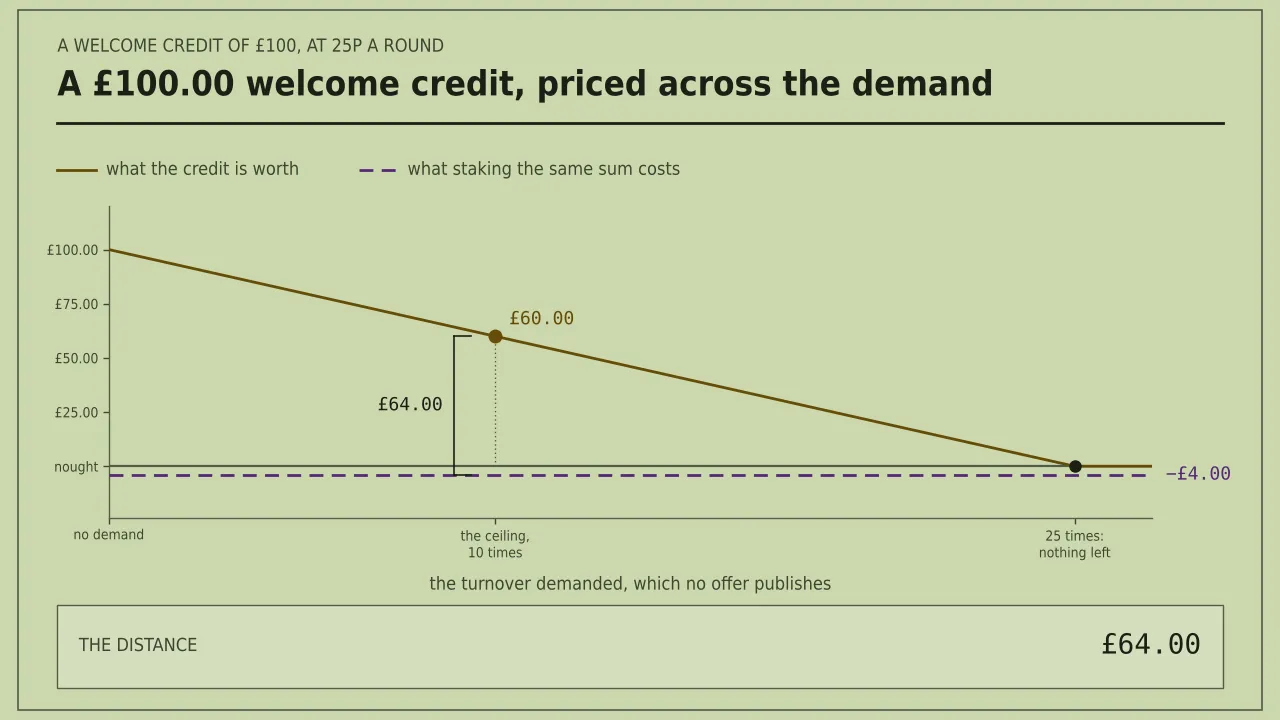
A welcome offer is usually two or three unlike things with one number printed over them, and unlike things cannot be totalled. Take the money half on its own: £100.00 of credit a figure chosen here, asked for ten turnovers, where a played pound comes back as 96 pence under the industry-wide value this publisher carries and borrows from no title, comes to £60.00. The identical £100.00 staked out of a reader’s own account is expected to cost £4.00 and leaves nothing owing. That is £64.00 between the findings, or 256 rounds at 25p, and anything bundled beside the credit gets its own column rather than being added to this one. No licensee may lawfully be asked for more than ten turnovers, which puts £64.00 at the bottom of the range the distance can take.
| What is being priced | Priced as a free round | Priced as a paid round | The gap between the two |
|---|---|---|---|
| Paid in by the reader | nothing | £100.00 | £100.00 |
| Credited to the balance | £100.00 | £100.00 | none |
| Cost of one turnover | £4.00 | £4.00 | none |
| Cost of nine more | £36.00 | nothing owed | minus £36.00 |
| What it comes to | £60.00 | minus £4.00 | £64.00, or 256 rounds |
What the free round comes to £60.00 A thousand pounds of play has to come off £100.00 of credit, and the £40.00 it costs on the way leaves £60.00 behind. What the paid round comes to minus £4.00 A hundred pounds from the reader’s own account, through one pass of the identical play, owing nothing to anybody afterwards. The gap, in money and in rounds £64.00, 256 rounds The second figure deducted from the first, and the answer restated as rounds at the stake named here.
Free rounds and what each asks in return
Paid placements are what these addresses are. A registration made through one brings this publisher a fee. Neither quote knows which address is which, and no figure on a bout would differ if it did.
-
01Free Play Arena
Betportal
Thirty-five times, three deposits
What the free side comes tonothing150 rounds at 10c, across a play-through of 35 timesWhat the same play costs paid forminus 60cthe identical play behind the reader's own stake, where the only cost is the return itself and no play-through is owedThe distance, in money and in rounds60cthe two findings subtracted, and the same distance said again as 6 rounds at the stake aboveOffered free
How the free side is pricedA count of rounds the offer stakesRounds counted150 roundsWorth of one round10cstated by this publisher, as a quantity of the money this offer is quoted in, no operator having valued a round of its ownCredited as a sumunpublishedCredit waiting on a paymentstated300% over three deposits, ceiling €1,000The face of it€15.00Rounds priced at the stake this publisher states, in the money this offer is quoted in, no operator having valued a round of its ownAsked in return
Play-through35 timesthe bonusCredited towards it100 per centno share has been published anywhere, so every penny counts, that being the kindest available reading of the silencePrices out above25 timesagainst the return assumed here and the share above, any play-through beyond this leaves the free quote worth nothing whateverCeiling on winningsstatedFive times the bonusLargest stake while it runs€5.00capping the stake closes off part of whatever range a lobby offers, and keeps it closed while the credit lastsQualifying payment€20.00200 rounds at the worth above, and no price here touches itOne play priced on both sides of the free line Priced step by step With the offer staking With the reader staking The distance What goes in first nothing minus €15.00 €15.00 What the staking hands back €14.40 €14.40 none What the play-through takes minus €20.16 nothing owed minus €20.16 What it comes to nothing minus 60c 60c, or 6 rounds The play-through asked here is at or past 25 times, the point where the condition costs more than it is laid against, so the free side comes to nothing whatever and the distance is the paid cost by itself.
No licence for Great Britain
Licence held in Anjouan, Comoros, by BetPortal Gaming Ltd, with Excite Ultra Media Ltd, under number ALSI-202601040-FI2.
Open the offer at Betportal, opens in a window of its own -
02Free Play Arena
WinBeast
Five deposits, with a free bet
What the free side comes tonothing500 rounds at 10c, across a play-through of 40 timesWhat the same play costs paid forminus €2.00the identical play behind the reader's own stake, where the only cost is the return itself and no play-through is owedThe distance, in money and in rounds€2.00the two findings subtracted, and the same distance said again as 20 rounds at the stake aboveOffered free
How the free side is pricedA count of rounds the offer stakesRounds counted500 roundsWorth of one round10cstated by this publisher, as a quantity of the money this offer is quoted in, no operator having valued a round of its ownCredited as a sumunpublishedCredit waiting on a paymentstated50% to 100% over five deposits, each ceiling €1,000, with a €650 free betThe face of it€50.00Rounds priced at the stake this publisher states, in the money this offer is quoted in, no operator having valued a round of its ownAsked in return
Play-through40 timesthe bonus and the winnings from the spinsCredited towards it100 per centno share has been published anywhere, so every penny counts, that being the kindest available reading of the silencePrices out above25 timesagainst the return assumed here and the share above, any play-through beyond this leaves the free quote worth nothing whateverCeiling on winningsstated€100 a batch of spinsQualifying payment€20.00200 rounds at the worth above, and no price here touches itOne play priced on both sides of the free line Priced step by step With the offer staking With the reader staking The distance What goes in first nothing minus €50.00 €50.00 What the staking hands back €48.00 €48.00 none What the play-through takes minus €76.80 nothing owed minus €76.80 What it comes to nothing minus €2.00 €2.00, or 20 rounds The play-through asked here is at or past 25 times, the point where the condition costs more than it is laid against, so the free side comes to nothing whatever and the distance is the paid cost by itself.
No licence for Great Britain
Licence held in Curaçao, behind a company the site declines to name.
Open the offer at WinBeast, opens in a window of its own -
03Free Play Arena
EliteSpin
Forty times, five deposits
What the free side comes tonothing500 rounds at 10p, across a play-through of 40 timesWhat the same play costs paid forminus £2.00the identical play behind the reader's own stake, where the only cost is the return itself and no play-through is owedThe distance, in money and in rounds£2.00the two findings subtracted, and the same distance said again as 20 rounds at the stake aboveOffered free
How the free side is pricedA count of rounds the offer stakesRounds counted500 roundsWorth of one round10pstated by this publisher, as a quantity of the money this offer is quoted in, no operator having valued a round of its ownCredited as a sumunpublishedCredit waiting on a paymentstated50% to 100% over five deposits, each ceiling £1,000The face of it£50.00Rounds priced at the stake this publisher states, in the money this offer is quoted in, no operator having valued a round of its ownAsked in return
Play-through40 timesthe bonus and the winnings from the spinsCredited towards it100 per centno share has been published anywhere, so every penny counts, that being the kindest available reading of the silencePrices out above25 timesagainst the return assumed here and the share above, any play-through beyond this leaves the free quote worth nothing whateverCeiling on winningsstatedFive times the bonusQualifying payment£20.00200 rounds at the worth above, and no price here touches itOne play priced on both sides of the free line Priced step by step With the offer staking With the reader staking The distance What goes in first nothing minus £50.00 £50.00 What the staking hands back £48.00 £48.00 none What the play-through takes minus £76.80 nothing owed minus £76.80 What it comes to nothing minus £2.00 £2.00, or 20 rounds The play-through asked here is at or past 25 times, the point where the condition costs more than it is laid against, so the free side comes to nothing whatever and the distance is the paid cost by itself.
No licence for Great Britain
Licence held in Costa Rica, by PrimeTier Limited.
Open the offer at EliteSpin, opens in a window of its own -
04Free Play Arena
Nightluck
No play-through published
What the free side comes toNOT STRUCKNot struck in full, for want of the count of rounds this offer puts up.What the same play costs paid forNOT STRUCKNot struck in full, for want of the count of rounds this offer puts up.The distance, in money and in roundsUNPRICEDone of the two sides is short of a figure, so nothing is subtracted here and nothing is struckOffered free
How the free side is pricedA count of rounds the offer stakesRounds countedunpublishedWorth of one round10pstated by this publisher, as a quantity of the money this offer is quoted in, no operator having valued a round of its ownCredited as a sumunpublishedCredit waiting on a paymentstated100% of the first deposit, ceiling £300The face of itunpublishedAsked in return
Play-throughunpublishedThe offer page sends a reader to the terms for the multiple and prints no figure itselfCredited towards it100 per centno share has been published anywhere, so every penny counts, that being the kindest available reading of the silencePrices out above25 timesagainst the return assumed here and the share above, any play-through beyond this leaves the free quote worth nothing whateverCeiling on winningsunpublishedQualifying payment£10.00100 rounds at the worth above, and no price here touches itNot struck in full, for want of the count of rounds this offer puts up.
No licence for Great Britain
The site names no jurisdiction for its licence, behind a company the site declines to name.
Terms read 22 October 2026
Open the offer at Nightluck, opens in a window of its own
Three quantities on a bout were worked out here. Everything else was transcribed. The free quote comes off E = B × (1 − W × (1 − RTP) ∕ g), where W is whatever play-through the terms demand, g is the proportion of a qualifying stake that counts towards it, RTP is the return assumed of an ordinary slot, and B is whatever is left standing by the time the condition applies. A batch of rounds surrenders part of itself before that point, every round having staked its value and taken the return against it, while a credited sum surrenders nothing at all yet, nothing having gone through the machine. Past break-even the charge exceeds whatever it is charged against, and the free quote settles at nothing rather than below it, nothing being removable beyond what turned up.
The paid side is cost = N × s × (1 − RTP), and it is the figure that makes this bill different from every other ranking in this network. The identical count of rounds at the identical stake, with the reader's own money behind them, hands the margin over once and owes nothing afterwards, there being no credit to turn over and no ceiling to come under. So the two sides are not two readings of one offer. They are one play at two prices, and the distance between them is what the word free is worth on that bout, said as a sum and said again as a count of rounds, because a reader counts in rounds and pays in money.
Read the reckoning downwards and the distance column adds up to the finding. It opens at whatever the paid side has to put in before a round turns, loses whatever the free side gives up that the paid side does not, and closes at the answer, so the bout can be checked without any of it being worked again. A step where both sides move alike leaves the distance reading none, which says the return treats the two the same way there and the distance is made somewhere else.
On a bout whose free half is a demo, both of its own figures are nought and neither one is approximate. Cash has no route out of a demo, so a demo balance showing five hundred pounds settles at nought, and the distance comes out at exactly what buying the rounds costs. Those noughts are findings rather than figures somebody held back. Where a figure really is absent, one of three words takes its place instead. Stated means a condition written out in sentences, which costs something and offers nothing to subtract. Unpublished means a condition written down nowhere whatever. Unpriced means a count published clearly enough, with nothing anywhere putting a value on one of them. None of the three conceals an approximation, and nobody here is credited with a figure they never supplied.
Two figures on every bout belong to this publisher and are stated rather than read. The return both sides are worked at is a general industry figure for an ordinary slot: it is an assumption of this publisher's, it is not read off any title or off anybody who builds one, and a line that spends it says so where it spends it. The worth of one round is the other, and it is spent only where no operator has put a worth on one of its own, nobody publishing a minimum or a maximum for that and no rule setting either. Every bout spending that figure prints whose figure it is. Everything else in a bout was quoted out of an operator's own terms on the day recorded at its foot.
Four duties written by a Great Britain licence come down on the free column of a bout. None of the four comes down on the paid column, because nothing is advanced there for a condition to attach itself to, and that lopsidedness is the argument of the whole bill. Limb 3(a) of Social Responsibility Code 5.1.1 took effect on 19 January 2026 and forbids a holder to ask that bonus funds be played through more than ten times over. Read the play-through term above against that: anything beyond ten times is a term no British holder could have published. Whether a free round counts as bonus funds for the purposes of that limit has not been published in either direction, so this publisher asserts neither reading of it. Statutory Instrument 2025 No. 215, made on 25 February 2025, inserted regulation 5(2), under which no individual may stake more than £5 on a single game cycle of an online slot, falling to £2 under the age of 25. That limit fastens itself to the operating licence rather than to any game, so beyond the licence a lobby offers whatever stake range it pleases with nothing standing over the top of it. Requirement 3C of the remote technical standards obliges a holder to make the rules of a game available before anybody commits money to it. Both quotes above rest on an assumed return rather than a published one, and that duty is the reason an assumption is needed at all out here. Membership of Gamstop Online is a condition of holding the British licence, so the scheme stretches exactly as far as the licence stretches and no further. An offer licensed beyond it sits outside by construction, and a registration somebody has already completed does not reach this offer. Free and confidential help is on the National Gambling Helpline, 0808 8020 133, answering 24 hours a day on every day of the year.
Any condition quoted on a bout appears in the words of whoever published it, and every bout states the day somebody read it. The furthest back of those days on this bill is 22 October 2026. What binds a reader is an operator's own terms, entire, and never a line of this.
1
What a welcome offer is made of, and why the parts do not total
The phrase names a position in a cashier’s catalogue rather than a quantity. What actually arrives is a bundle: some credit set against a payment, often a count of free rounds, sometimes a second or third tranche hanging on later payments, and occasionally something that is not casino play at all. Those are different kinds of object. Credit is a sum of money under a condition. Rounds are a count that needs a stake before it becomes a sum. A later tranche is a sum that does not exist until another payment is made. Add them and the result is a number with no unit.
So this bill does what a reader should do, which is to price each part on its own and then refuse to total them. The money half is £100.00 of credit named by this publisher, a round figure chosen so that every result below divides cleanly and scales to any other size. Part two values it. Part four values a count of a hundred rounds beside it and keeps the two apart. Part five takes the tranches.
The separation is not fastidiousness. Totalling parts of unlike kinds always inflates, and it inflates by whichever part is being mislabelled. A hundred rounds at 25p has a face of £25.00, so a banner reading a hundred pounds plus a hundred rounds invites the arithmetic that gets £125.00, when the honest pair of findings is £60.00 and £14.40. Those two figures are both smaller than their faces and they are not addable, because one is money already in a balance and the other is money that has to be won by a count of rounds before any condition even starts.
One rule applies to the credit half throughout and it decides more than anything else on the page. The reader’s own payment is never part of what gets valued. A welcome offer at one hundred per cent on £100.00 leaves £200.00 on the screen, half of it the reader’s and under no condition at all, and no sum about the generosity of an offer may contain money the reader brought with them. Every figure on this bill is about the credited £100.00 and the payment is held in a separate column wherever it appears.
2
A hundred pounds of credit, and what ten turnovers leave of it
One expression does the valuing: E = B × (1 − W × (1 − RTP) ∕ g), and four quantities feed it. The credited balance is £100.00. The condition asks ten turnovers, that being as far as a British licence lets an incentive go from the rule sheet. A pound played comes back as 96 pence, an industry-wide value this publisher carries and borrows from no title ours, and marked as ours. And a pound staked discharges a whole pound of the condition, which is how a weighting nobody has published gets read on this bill.
Longhand, in three moves. The condition calls for a thousand pounds of play, being ten lots of £100.00. Four pence out of every pound played fails to return, so £1,000.00 of play costs £40.00 as it happens. A hundred pounds reduced by £40.00 is £60.00, and £60.00 is the value of the credit half of a welcome offer at this size and this condition. Three fifths of a credited sum lives through ten turnovers at this return, and the fraction is the same whatever the sum.
A thousand pounds is the quantity worth noticing. At 25p a round the stake used here it is 4,000 rounds of play, which is the work a reader has to do before a penny of the £60.00 can be taken anywhere. Nothing on a welcome banner mentions four thousand of anything, and the £1,000.00 is a larger and more decisive number than either of the two findings this bill prints.
Two hedges belong beside the £60.00. It is an average over many attempts and not a payout: a single run at £1,000.00 of play off £100.00 of credit most often finishes empty, and the average owes its size to a minority of runs. And ten turnovers is a courtesy rather than a constraint, being a limit on a British licensee, while the sort of cashier written about here carries no Great Britain licence and answers to nothing of the kind. Part eight prices the same credit where the limit is absent.
3
The same hundred pounds staked out of a reader’s own account
Now the second price, which is what makes this a bill rather than a description. Suppose the £100.00 belongs to the reader and crosses the same play a single time. Since no advance was made there is nothing to discharge. The condition is absent, the weighting cannot matter, no cap on winnings can reach it, and the only charge is the ordinary one.
A hundred pounds across play where four pence a pound stays put is expected back as £96.00, so the pass costs £4.00, entered on the bill as minus £4.00. Set against the £60.00 the credit is worth, the two findings are £64.00 apart, and £64.00 at 25p a round is 256 rounds. A reader thinks in rounds and settles in money, so the distance is printed in both.
a credited £100.00 valued at £60.00, the identical £100.00 out of a reader’s own account costing £4.00, £64.00 between the two findings and 256 rounds of play inside the difference
Hold £4.00 against £40.00 and the whole of this site’s question is in the pair. Play is priced identically on both sides, four pence in the pound, indifferent to who owns the stake. The gap exists because one side has to buy ten times as much play as the other before anything can leave the building. The condition is not a fee and not a charge on winnings. It is a purchase order for £900.00 of extra play, and that order costs £36.00.
None of which argues against accepting. A reader who takes the credit is taking something worth about £60.00 for no money, which is plainly worth doing. Anybody who thinks £100.00 has changed hands is out by £40.00, and anybody reading the £200.00 on screen as the size of the offer is out by £140.00. The arithmetic does not say refuse. It says know which of the three numbers is the one that behaves like money.
4
The rounds half, priced on its own and never added in
Where a welcome bundle carries a count of rounds as well as a credit, the rounds want their own arithmetic and their own line. A count is not a sum: it becomes one only once a stake per round is known, and a stake per round is almost never published, so this bill supplies 25p a stake stated by this publisher and says plainly that the figure is ours. A hundred rounds at 25p has a face of £25.00.
From there the method differs from the credit half in one respect that matters. Free rounds stake themselves, so the balance receives not the face but the face after play has had its cut: £25.00 of staking returns £24.00 at the rate named here. That £24.00 is then the B the expression works on. Ten turnovers of it costs two fifths, so the rounds half comes to £14.40. Priced as a paid round instead, a hundred rounds at 25p funded by the reader cost £1.00 and owe nothing, which puts the two rounds findings £15.40 apart.
| Half of the bundle | Face printed on it | Worth as a free thing | Cost as a paid thing |
|---|---|---|---|
| The credit | £100.00 | £60.00 | £4.00 |
| A hundred rounds at 25p | £25.00 | £14.40 | £1.00 |
| Both together | not addable | not addable | not addable |
That bottom row is what this part exists to print, and it is deliberate. One half is money already credited and the other is a count that has to be played before it becomes money at all, and the second depends on a stake this publisher chose. Printing £74.40 as the value of the bundle would hide an assumed stake inside a figure that looks read rather than supplied, and it would put a sum that exists under a condition beside a sum that has to be won first. The honest output is two findings side by side.
There is a further reason not to total them, and it is about the terms rather than the units. The condition on a credit and the condition on winnings from free rounds are frequently different numbers, and nothing requires them to match. Where the second is not published, the rounds half cannot be valued at all and this bill would report it unpriced rather than borrow the credit’s ten turnovers for it. The £14.40 above stands only because one condition was applied to both halves, and that is an assumption carrying a flag.
5
A headline only a reader who makes every payment ever reaches
An opening offer is often not one offer but a short series, with credit attached to a first payment, a second and sometimes a third. The number on the banner is then the sum of all the tranches, which means it describes a reader who has made every payment in the sequence and nobody else. A reader who makes the first payment and stops has reached the first tranche, and the headline was never about them.
| Payment made | Credit it draws | Credit reached so far | Value of what has been reached |
|---|---|---|---|
| First, £50.00 | £50.00 | £50.00 | £30.00 |
| Second, £30.00 | £30.00 | £80.00 | £48.00 |
| Third, £20.00 | £20.00 | £100.00 | £60.00 |
Three fifths runs down the last column, which is the point: tranching changes nothing about the rate. What it changes is who the headline describes. A reader who stops after the first payment has £30.00 of value and a banner that said £100.00 of credit, and nothing has gone wrong except that the banner was a total and the reader made a part. Each line of that table is also an independent condition, so the play owed arrives in instalments as well: £500.00, then £300.00, then £200.00, for a thousand in all.
Which makes the useful question a different one. Instead of asking what a welcome offer is worth, a reader can ask what the first tranche is worth, since the first tranche is the only part they are certain to meet. On these figures that is £30.00 against a £50.00 payment, with £500.00 of play attached, and a decision taken on those three numbers is a decision about something real. A decision taken on £100.00 is a decision about a sum that requires two further payments to come into existence.
6
One product or two, and the rule that would forbid the second
Four kinds of gambling are named for this purpose by British rules, which then bar a licensee from putting two of those kinds inside one incentive off the rule sheet. The four are betting, casino play, bingo and lottery. That rule reaches straight into the shape of a welcome bundle. A credit plus a count of rounds stays on one side of the line, both being casino play. A credit plus bingo tickets crosses it, and a credit plus a free bet crosses it as well.
Three exceptions cut against what a reader would guess, and each leaves lawful a bundle that looks caught. Two things of a single kind in one incentive are permitted. Two distinct offers covering two kinds may share an email where the reader has asked for news of both. And credit a reader is free to spend wherever they choose escapes the bar entirely, which is the exception a welcome bundle most often sits inside.
For this bill the consequence is a valuation problem rather than a legal one. Where a £100.00 credit is spendable across kinds of play with different returns, the 96 per cent used in part two is a value for one kind, and a reader moving the credit onto something with a different published return has moved off the figure the £60.00 rests on. This bill does not hold a sheet of returns for named games and will not invent one, so the honest statement is that £60.00 holds at the industry value named above and moves wherever the credit is spent on play that returns something else.
The second consequence is about which conditions attach to what. A bundle crossing two kinds of play usually carries conditions that differ between the halves, and a reader trying to value the whole has to find both. One number on a banner over parts with two conditions is a number that describes neither, which is the same objection part four made about units, arriving by a different road.
7
A practice balance of a hundred pounds, and the nought beside it
A practice balance showing £100.00 hands over nought. Not a reduced £60.00, not £60.00 behind a longer condition, and not a figure somebody would publish if asked. Nought, and nought for a structural reason: a practice balance has no outlet at all, which holds just as firmly for one reading five hundred pounds.
Send a practice balance down the instrument’s four columns and its free side is nought at every row, so the distance and the paid figure become one quantity, minus £4.00. The noughts are the result. An evening spent running a practice £100.00 up to £1,500.00 has produced no information about this offer, because the quantity examined here is a cost, and costs are precisely what the design of a practice balance excludes.
Three screens can read £100.00 and be worth £60.00, minus £4.00 or nought, and no photograph would separate them. What separates them is an agreement, and the agreement is the thing a welcome banner is designed to postpone. A reader who reads the terms before the balance has the parts in the right order.
8
What a welcome headline never states, and the totals left unstruck
Three quantities this bill needs are not published, and each gets named instead of guessed at. The stake per round in part four is the first: without it a count of a hundred rounds is not a sum of money, so 25p was supplied by this publisher and the £14.40 carries that assumption visibly. The condition on winnings from those rounds is the second: the ten turnovers borrowed from the credit half is an assumption too, and where a separate figure applies and is unstated, the rounds half would be reported unpriced rather than filled in. The third is the turnover count on the credit, which nothing states, the words on a banner naming a kind of arrangement rather than any single set of terms.
So no single total gets struck here and none should be. The credit half is £60.00 against a cost of £4.00 under stated assumptions. The rounds half is £14.40 against £1.00 under two of them. They are not added, the series in part five means the headline describes a reader who makes every payment, and and where the weighting turns out to be thirty pence in the pound rather than a full one, feeding that into E = B × (1 − W × (1 − RTP) ∕ g) gives ten turnovers of £100.00 wanting £3,333.33 of play, with the £60.00 at nought. An invented figure to close a sum would be unfalsifiable; a stated hole can be checked by anybody who finds the term.
£64.00 wants reading as a floor and not as a typical figure. No licensee may lawfully be asked for more than ten turnovers, so no lawful condition yields a narrower distance, and five turnovers would widen this one to £84.00. Beyond the ceiling the gap contracts instead, to £24.00 at twenty turnovers and to the £4.00 a single crossing costs at twenty-five, which is territory a cashier outside the regime can reach. The floor reports that credit comes out ahead of paying by £64.00 or better wherever the law holds.
A bundle of this shape reaching a reader in Great Britain carries no Great Britain licence. Three duties attached to one would show up in the numbers above. Two kinds of gambling may not sit inside a single incentive off the rule sheet, so a licensed version could hold the £100.00 and the hundred rounds, both of them casino play, and could not staple a free bet beside them. Marketing needs consent for each kind of play and for each route it travels by, gathered in advance, so the message carrying the £100.00 would have been asked for rather than simply arriving. And what has been spent and how long has gone on it have to be put in front of a player as play proceeds, which would make the £40.00 that £1,000.00 of play costs visible while it was going rather than afterwards. Without that licence none of the three applies, and the £60.00 rests on a count no document anybody is obliged to publish would confirm.
The finding is four lines long. A welcome offer is a bundle, and its parts are of unlike kinds, so they get priced separately and never summed. The credit half, at £100.00 and ten turnovers, is worth £60.00, while the same £100.00 staked by the reader costs £4.00, which places the findings £64.00 or 256 rounds apart. A hundred rounds bundled beside it is worth £14.40 against a cost of £1.00, at a stake this publisher supplied. And the headline sum is reachable only by a reader who makes every payment in the series, the first tranche on these figures being worth £30.00.
Questions
- What is a casino welcome bonus really worth?
- The money half of one keeps three fifths of the credit at ten turnovers, where a played pound returns 96 pence. On £100.00 of credit that is £60.00, with £1,000.00 of play owed. The same £100.00 staked by the reader would cost £4.00, so the two findings sit £64.00 apart, which is 256 rounds at the 25p named on this bill.
- Can I add the bonus cash and the free spins together?
- No, and doing so is the commonest way a bundle is overstated. Credit is a sum under a condition; rounds are a count that needs an assumed stake before they are a sum at all. Priced apart, £100.00 of credit comes to £60.00 and a hundred rounds at 25p come to £14.40, and the two figures describe different kinds of thing.
- Does my first deposit get me the whole welcome offer?
- Only where the offer has one tranche. Where the headline is a total across three payments, a reader who makes the first reaches the first tranche and no more. On the series worked here, a £50.00 first payment draws £50.00 of credit worth £30.00 with £500.00 of play attached, against a banner that named £100.00 of credit.
- How much wagering does a £100 welcome bonus come to?
- A thousand pounds, being ten turnovers of the credited £100.00, which comes to 4,000 rounds at 25p. Where a qualifying game counts as only thirty pence in the pound, the same ten turnovers want £3,333.33 of play and the credit is then worth nought instead of £60.00. The turnover count is the figure no banner states.
- Does my deposit count towards the bonus being valued?
- It does not. At one hundred per cent on £100.00 the screen reads £200.00, half of it the reader’s own money under no condition whatever, and a valuation of an offer may not contain money the reader brought with them. The figure being valued is the credited £100.00, and the payment sits in its own column throughout.
- Why do bonus cash and bingo tickets never come in one offer from a licensed site?
- Because four kinds of gambling are named by British rules and a licensee may not put two of them inside one incentive. Casino credit beside casino rounds stays on one side of that line. Three exceptions soften the bar, among them credit a reader is free to spend wherever they choose.
- Can practice mode show me what a welcome bonus is worth?
- It cannot. A practice balance reading £100.00 hands over nought for a structural reason and not because of a term, no outlet existing at all. Neither column of that arithmetic leaves nought, neither nought is an estimate, and a practice run to £1,500.00 says nothing about £60.00, about minus £4.00, or about the £1,000.00 of play behind the first of them.